


Free Shipping All Orders Over $95
If two jars carry the same strain name, why can one test far stronger, smell fruitier, and feel more relaxing than the other? That gap is where most buying mistakes happen. The Cherry Gary strain is a useful example because its name sounds precise, yet its genetics, potency, and terpene results can shift from grower to grower and batch to batch. Treat the name as a starting label, then let aroma, lab numbers, and dose timing tell you what you're getting.
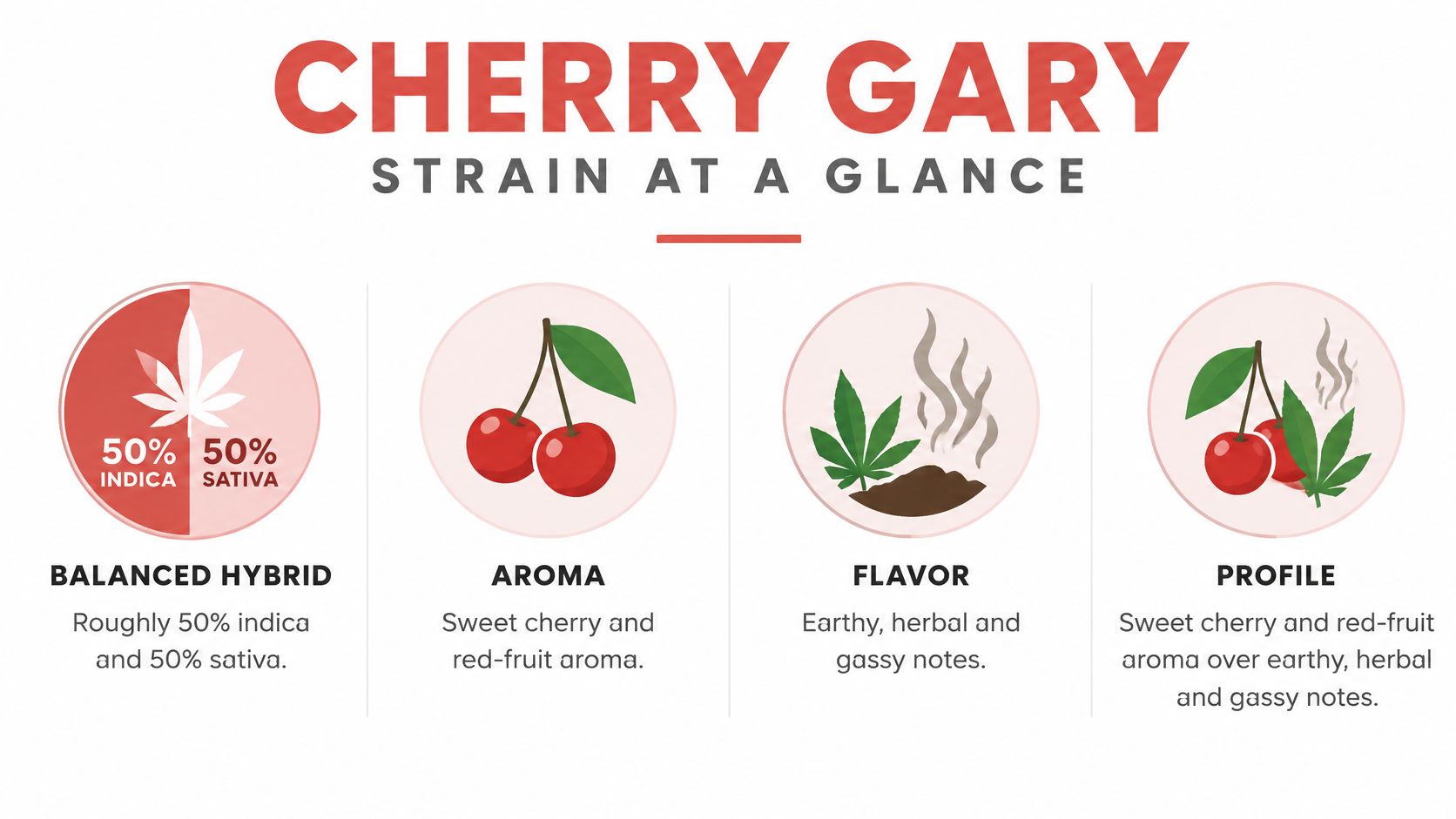
Cherry Gary is described as a balanced hybrid, roughly 50% indica and 50% sativa, with sweet cherry and red fruit over earthy, herbal, and gassy notes. That balance is an approximation from product descriptions, not a measured ratio you can verify in a lab.
Think of the profile below as a snapshot from specific listings, not a promise for every jar. A breeder range tells you what a producer reports across a line, while a single pre-roll result tells you only what one batch tested at on one day.
| Attribute | Reported value | Confidence note |
|---|---|---|
| Category | Balanced hybrid, roughly 50% indica and 50% sativa | Approximation, not a verified ratio |
| Lineage | Gary Payton × Lemon Cherry Gelato (most cited) | Naming varies by source, verify the batch |
| THC (breeder listing) | 18–22% | 2025 StrainCompass listing for 808 Genetics |
| THC (pre-roll results) | 27.8–30.2% | Single retail batches, not a strain average |
| CBD | 0–1% (listing), 0.08% (one pre-roll) | Low in every cited figure |
| Aroma | Sweet cherry, red fruit, earth, herbal, gas | Descriptive, from product copy |
| Leading terpenes | β-caryophyllene, limonene, myrcene, linalool | Reported as leading, percentages not available |
The widest range comes from the 2025 StrainCompass listing for 808 Genetics, which reported Cherry Gary at 18–22% THC and 0–1% CBD. Read that as a broad listing range. It doesn't override a higher or lower result on the batch in front of you.
Notice how CBD stays low across the cited figures. That means there's little CBD in these listings to soften the THC effect, so dose size matters more than the hybrid label might suggest.
One-line takeaway: the name is a starting point, and the batch certificate of analysis is the real specification.
Use the table to frame questions, not to settle them. If a seller quotes only the top number, ask whether it's a breeder range, a single lab result, or the current batch.
Cherry Gary belongs to a modern wave of breeding that pairs dessert fruit with fuel. Breeders took cultivars known for sweet, candy-like aroma and crossed them with gassy, assertive lines, aiming for flower that smells inviting in the jar and tastes deeper on the exhale. It's not an old heirloom preserved for decades. It's a recent hybrid built for current tastes.
A recipe analogy helps. Gary Payton is commonly cast as the backbone, contributing the earthy and gassy structure. The cherry-forward parent adds the sweet top notes, the way a sauce changes a dish without replacing the main ingredient. Change either parent, or select a different offspring from the same cross, and the finished flavor shifts.
Documentation around the exact formula isn't settled. The Joint Commerce strain guide on Gary's Cherries by Envy Genetics notes that available documentation most commonly associates the name with a cross involving Gary Payton and a cherry-forward parent, while some sources specifically describe Gary Cherry, also called Cherry Gary, as Gary Payton × Lemon Cherry Gelato. The same guide stresses that breeder documentation hasn't consistently established one universally accepted genetic formula, so the name may be phenotype or producer specific.
Names in this corner of the market sound alike but don't always point to the same plant. Cherry Gary and Gary Cherry are sometimes used for the same Gary Payton cross. Other catalogs list Cherry Garcia or Cherry Gar-See-Ya with a different lineage, Animal Cookies × 3X Crazy. A shopper who relies on sound alone can easily buy a different genetic line while thinking they've found the same one.
A family photo analogy fits here. Knowing the parents tells you something about likely traits, but siblings don't look identical. One plant may lean sweet and bright, another may lean earthy and heavy, even when they come from the same seed batch.
For expectations, treat lineage as a claim to check rather than a guarantee. It can suggest why cherry and gas appear together, but it can't tell you the THC percentage or terpene order of a specific lot. That job belongs to batch testing, which measures the flower you can buy.
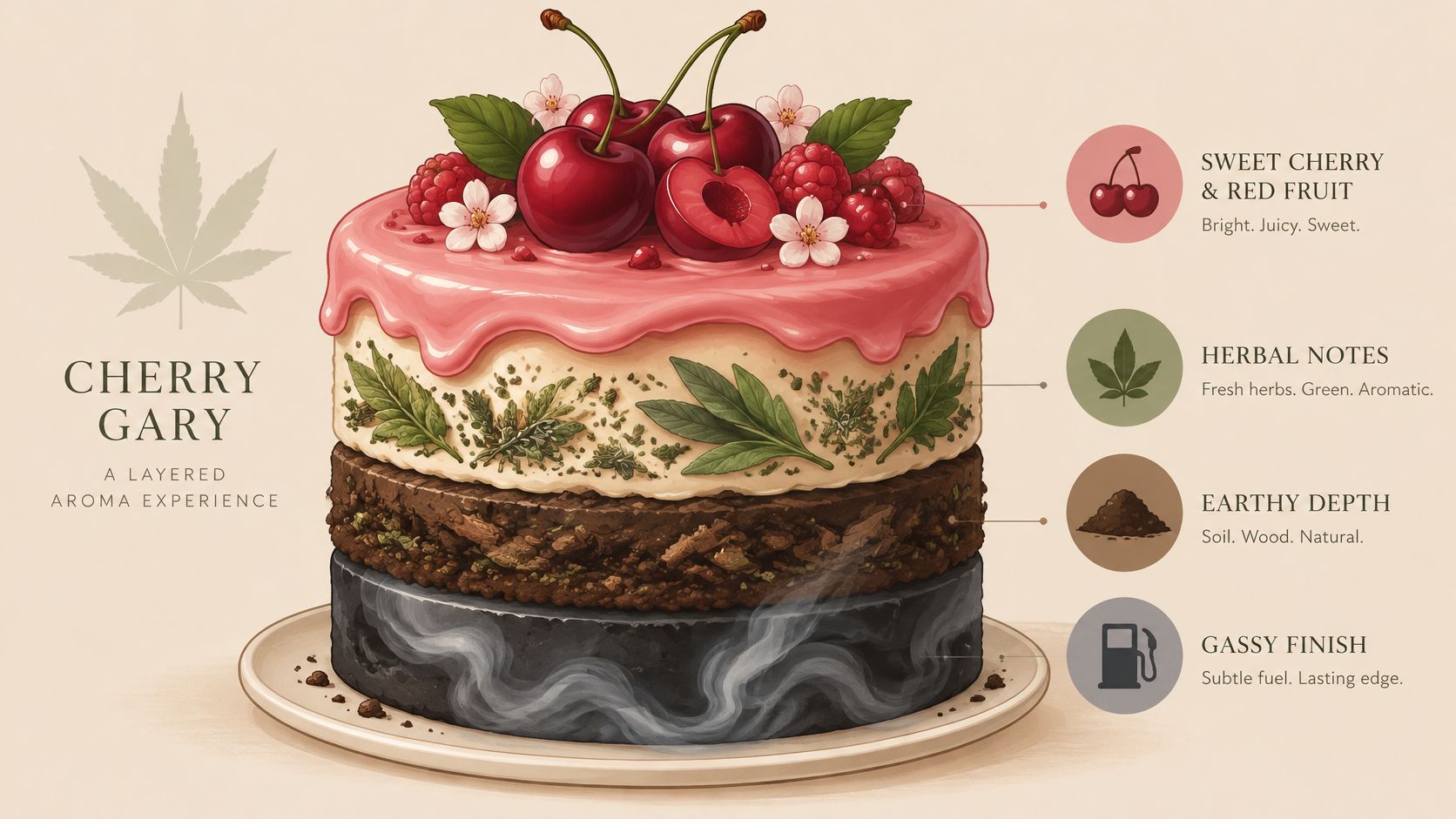
The sensory picture is simple to state. Sweet cherry and red fruit come first, earth and herbal notes sit underneath, and a fuel edge shows up at the end. If you only get sweetness with nothing beneath it, you're probably smelling a different cut or a tired batch.
Picture a layered cake. The cherry note is the frosting, bright and noticeable the moment the jar opens. Earth, herbs, and gas are the sponge, less showy but responsible for the depth that keeps the sweetness from tasting flat or artificial.
The Strainpedia entry for Gary Cherry describes a terpene pattern led by β-caryophyllene, limonene, myrcene, and linalool, alongside reported THC around 25–30% in some strain references. Treat those four as reported leaders, not a ranked recipe. Without batch percentages, you can't know which one dominates in a given jar.
β-Caryophyllene smells peppery, woody, and spicy, like cracked black pepper or warm spice. In Cherry Gary, it's the most plausible source of the sharper, fuel-like edge that cuts through the fruit. When this terpene leads, the exhale often feels warmer and less candy-like.
Limonene brings citrus peel and brightness. It's the lift that makes cherry read as fresh rather than syrupy, similar to how lemon zest brightens a dessert. If you're learning the basics, a plain guide to what terpenes in weed actually do can help you connect names like limonene to smells you already know.
Myrcene is earthy and musky, with a ripe, herbal quality. It grounds the blend and gives the profile weight. A myrcene-forward batch may smell less sparkling and more rounded, even if the cherry note is still present.
Linalool is floral and lavender-like. It adds a softer, slightly sweet layer that can make the fruit feel smoother. You may notice it most after grinding, when the sharper top notes settle and a gentle floral note remains.
Terpenes are volatile, which means they fade. Over-dried or poorly stored flower tends to lose its bright citrus character first, leaving a dull, hay-like smell. Heat, light, and repeated air exposure speed that loss.
If the cherry note is flat when you open the jar, check the harvest and packaging dates before you blame the genetics.
When you talk to a budtender, use two or three concrete terms. Say you want sweet cherry up front, earth underneath, and a light gas finish, then ask which current batch smells closest. That description works better than asking for a name alone, because it gives the staff a sensory target to match.
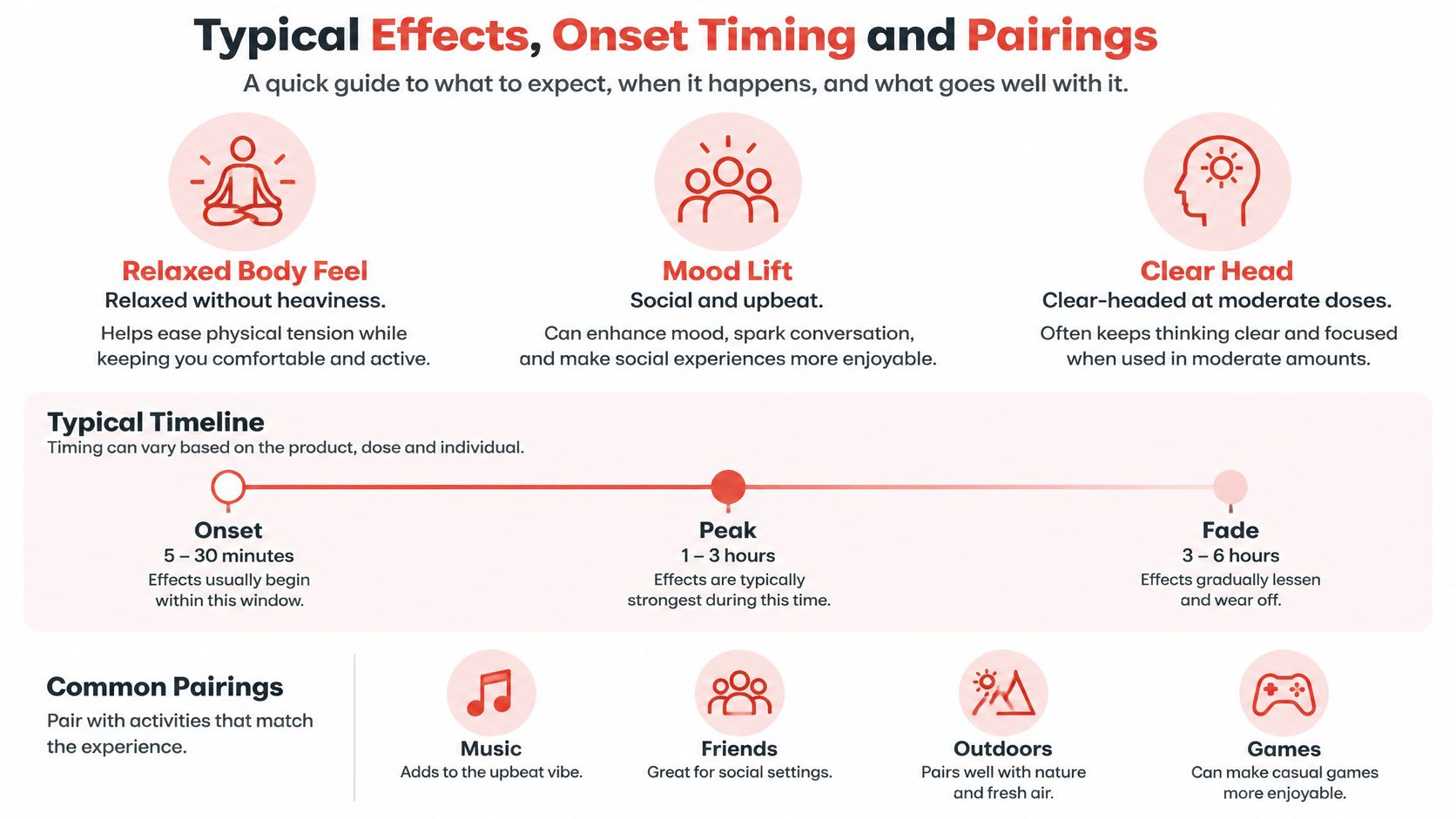
People usually describe Cherry Gary as relaxed in the body without feeling heavy, with a mood lift that suits conversation and a fairly clear head at moderate doses. Those are reported descriptions, not measured outcomes. Your tolerance, dose, recent food, sleep, and setting can change the result more than the hybrid label does.
Start with the setting you can control. A small dose before a walk with a friend is a different experiment from a larger dose on an empty stomach late at night. Don't drive or take on demanding tasks after any dose, even if the first few minutes feel mild.
The timeline below gives you a visual map before the method table adds numbers.
| Method | Onset | Peak | Typical duration |
|---|---|---|---|
| Inhaled (smoke or vape) | 2–10 minutes | 30–60 minutes | 2–3 hours |
| Edible | 30–120 minutes | 2–3 hours | 4–8 hours |
| Sublingual tincture | 15–45 minutes | 1–2 hours | 4–6 hours |
Inhaled flower gives the fastest feedback. You can take one or two puffs, wait at least 15 minutes, and decide whether you want more. That pause matters because the peak hasn't arrived when the first pleasant lift shows up.
Edibles surprise people for a biological reason. After you swallow THC, your liver converts part of it into a more potent compound, so the effect can build slowly and peak hours later. Taking a second edible because the first feels weak at 45 minutes is the classic mistake. Wait for the full window before you add more.
Sublingual tinctures sit between those extremes. Holding liquid under your tongue lets some cannabinoids absorb through the tissue there, while the rest is swallowed and processed like an edible. Expect a gentler ramp than smoking, but don't treat it as instant.
The short video below is a useful pause point to compare timing expectations before you plan a session.
Contrast two common plans. A daytime walk calls for the smallest dose and plenty of time before any obligation. An evening couch session allows a slower fade, but it still calls for restraint if you need a clear morning.
Start-low rule: take a small first dose, wait through the onset window for your method, then decide. You can add more later, but you can't subtract what you've already taken.
If the effect feels stronger than expected, stop dosing, sit down, hydrate, and give it time. Adding caffeine, alcohol, or more cannabis usually makes judging the experience harder, not easier.
The core rule comes first. THCA is the raw acid form found in unheated flower, and it isn't psychoactive in that form. Heat from smoking, vaping, or cooking triggers decarboxylation, which converts THCA into THC. That's why a label can show a modest Delta-9 number and still describe flower that feels strong after you light it.
Use this working formula when a report lists both values. Potential THC = (THCA × 0.877) + measured Delta-9 THC. The 0.877 factor accounts for the weight lost when THCA converts. It gives you an estimate of total THC after heating, not a guarantee of how strong a session will feel.
Say a flower listing shows 27.769% THCA and 0.2212% Delta-9 THC. Multiply 27.769 by 0.877 and you get about 24.35. Add 0.2212 and the estimated potential THC is roughly 24.6% after heating. That single calculation prevents two errors. You won't mistake the low Delta-9 figure for weak flower, and you won't treat the full THCA percentage as if every point becomes THC.
For a deeper walkthrough of the math, see this explainer on THCA versus THC percentage on a label. The habit to build is simple. Always ask whether a headline number means THCA before heating, Delta-9 as measured, or total potential THC after conversion.
| Source | Product | Reported THC or THCA | CBD or Delta-9 | What to note |
|---|---|---|---|---|
| 808 Genetics listing (2025) | Flower | 18–22% THC | 0–1% CBD | Broadest breeder range |
| Retail lab result | Pre-roll | 30.2% THC | 0.08% CBD | One batch, not a strain average |
| Second retailer | Pre-roll | 27.8% THC | CBD not reported | One batch, CBD not reported |
| PUFFY listing (2026) | Flower (Gary's Cherries) | 27.769% THCa | 0.2212% Delta-9 THC | Hemp-style split, THCA converts on heating |
The retail figures show why you shouldn't memorize one number. The JARS Cannabis Cherry Gary pre-roll listing is associated with a retail laboratory result of 30.2% THC and 0.08% CBD, while another retailer reports a comparable Cherry Gary pre-roll at 27.8% THC. Those are product results, not a fixed genetic trait.
Why do results move? Phenotype selection, growing conditions, curing, storage, and laboratory method all play a part. Two labs can also handle sampling differently. A responsible seller should be able to show you the report for the batch on the shelf, not just quote the highest figure ever associated with the name.
The hemp compliance angle adds another layer. Many hemp rules use a 0.3% Delta-9 THC limit on a dry-weight basis, so a measured Delta-9 value before heating carries legal weight for how a product is sold. That creates the edge case that confuses buyers. A product can display low Delta-9 before heating while carrying high potential THC once THCA converts. Both numbers can be accurate because they answer different questions.
Read a label in this order: total or potential THC, THCA, Delta-9, CBD, then the test date and batch number.
If one of those pieces is missing, slow down. A complete report lets you compare batches fairly. A headline percentage alone only tells you how the product is marketed.
Growers and buyers need different information, and honesty about gaps helps both groups. A verified flowering window and yield specific to Cherry Gary aren't well documented in the listings cited here. Defer to your seed or clone source for timing, and treat any exact yield promise with skepticism until you've run the cut in your own room.
As a general reference point, many indoor hybrids finish in roughly 8–10 weeks of flowering. That's a planning range, not a Cherry Gary specification. Your breeder's guidance and the plant in front of you should set the harvest call.
Curing decides whether the cherry note survives. Dry too fast and the aroma turns grassy. Jar too wet and you invite musty odors. A slow dry, careful trim, and sealed storage protect the terpenes that made the cut worth growing.
| Check | Good sign | Warning sign |
|---|---|---|
| Trichomes | Frosty, cloudy to amber heads | Clear, sparse, or shrunken heads |
| Bud structure | Dense, springy, even color | Crumbly, hay-like, dark spots |
| Aroma | Clear cherry-sweet and fuel notes | Flat, grassy, or musty smell |
| Moisture | Firm with a slight snap when bent | Damp, sticky, or moldy odor |
| Lab report | Current, batch-specific certificate of analysis | Missing, old, or generic report |
Use price as context, not proof. The 2026 PUFFY product page for Gary's Cherries flower listed the flower at 27.769% THCa and 0.2212% Delta-9 THC, with a price of $55. That example gives you three things to compare at once, potency format, price, and whether a current report supports the listing. A higher price doesn't guarantee a better cure or a cleaner test.
A report that matches the batch matters more than a beautiful bud with paperwork from a different lot.
When you inspect flower in person, start with smell, then structure, then the report. If the aroma is flat and the report is missing, attractive color shouldn't rescue the purchase. Good Cherry Gary should announce cherry and fuel before you grind it, and the lab data should confirm that the batch is what the label claims.
Buying well comes down to evidence for one specific lot. Genetics stories and strain pages can guide your curiosity, but they can't verify the jar, pre-roll, or bag you're about to pay for. A current certificate of analysis, often shortened to COA, is the document that ties chemistry and safety testing to that batch.
The visual checklist below condenses the verification habit into three moves.
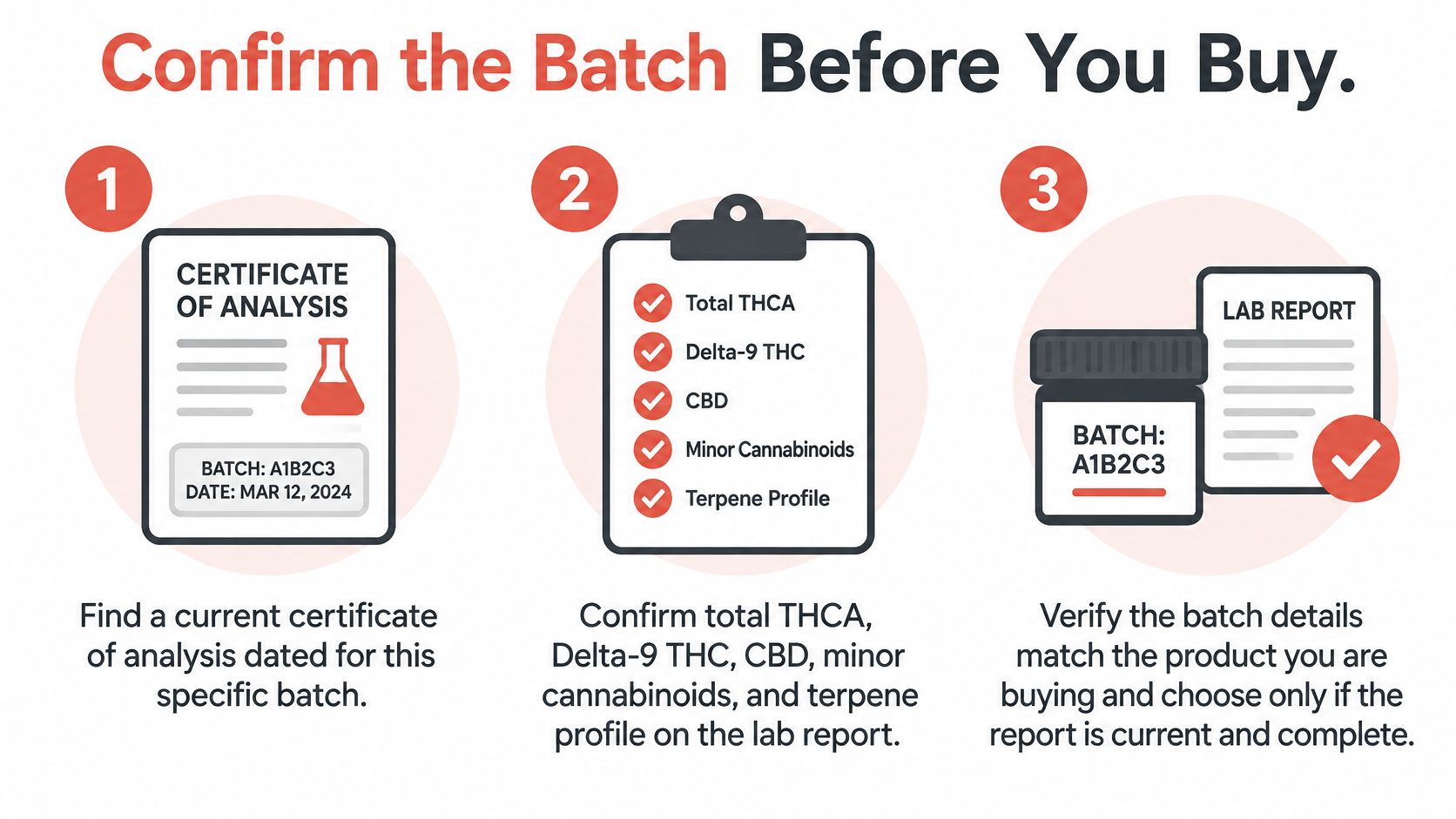
If you'd like the process explained in plain terms, this guide to what batch testing means for buyers walks through why lot-level results matter. The logic is straightforward. Lineage can vary by breeder and grower, cultivation can shift expression, and storage can fade aroma. The report is the only evidence that describes this lot after all of those variables have done their work.
Check the practical rules before you order. Confirm your local age requirement, which is 21+ in many markets, and review any shipping limits that apply where you live. Rules for hemp-derived products differ by place, and a seller's ability to ship doesn't remove your responsibility to know your local law.
End with one decision rule. Buy the batch whose report matches your target on potency, terpenes, and contaminants, or skip it and wait for a lot you can verify.
If you're shopping for Cherry Gary style flower and want batch lab reports you can read before you buy, Melt offers third-party tested THCA flower, disposables, prerolls, and edibles with strain-specific terpene profiles. Browse the current lineup, compare the certificates of analysis for the exact lot you're considering, and choose the potency and aroma that match your plan.
Your cart is currently empty.