


Free Shipping All Orders Over $95
You'll hear the same advice everywhere. Pick the cannabis flavored vape that smells strongest, tastes sweetest, or lists the longest row of strain names, and you've found the best one. That advice is backwards. Flavor intensity isn't proof of quality, and a bold mango or candy taste tells you almost nothing about what's in the oil, where that flavor came from, or what forms when you heat it.
Treat flavor as a chemistry question first and a taste question second. A good buy starts with two plain questions. What created this flavor, terpenes or added flavor agents? And can the seller show a batch-linked lab report that backs up the answer? If you can't answer both, you're buying a name on a package, not evidence about what you'll inhale. Research on the inhalation safety of flavor systems is still developing, so honest guidance has to leave room for what isn't settled yet.
Say two cartridges sit side by side and both say mango. One lists measured myrcene and limonene in its lab report, with concentrations for the exact batch in your hand. The other lists only the word mango. They might taste similar on the first pull, but they aren't giving you the same information, and they may not get their flavor from the same source at all.
Terpenes are aromatic compounds that occur naturally in cannabis and in many other plants. They're a large part of why one cultivar smells like citrus peel and another smells like pine, earth, or lavender. When a vape's flavor comes mainly from terpenes, you should be able to see which terpenes are present and at what concentration.
Added flavor agents are different. They're flavoring chemicals or blends mixed into the oil to create a specific profile, such as mango, candy, or dessert, even when the cannabis oil itself has little natural aroma. That doesn't automatically make a product good or bad. It does mean the flavor name alone doesn't prove the flavor came from the plant.
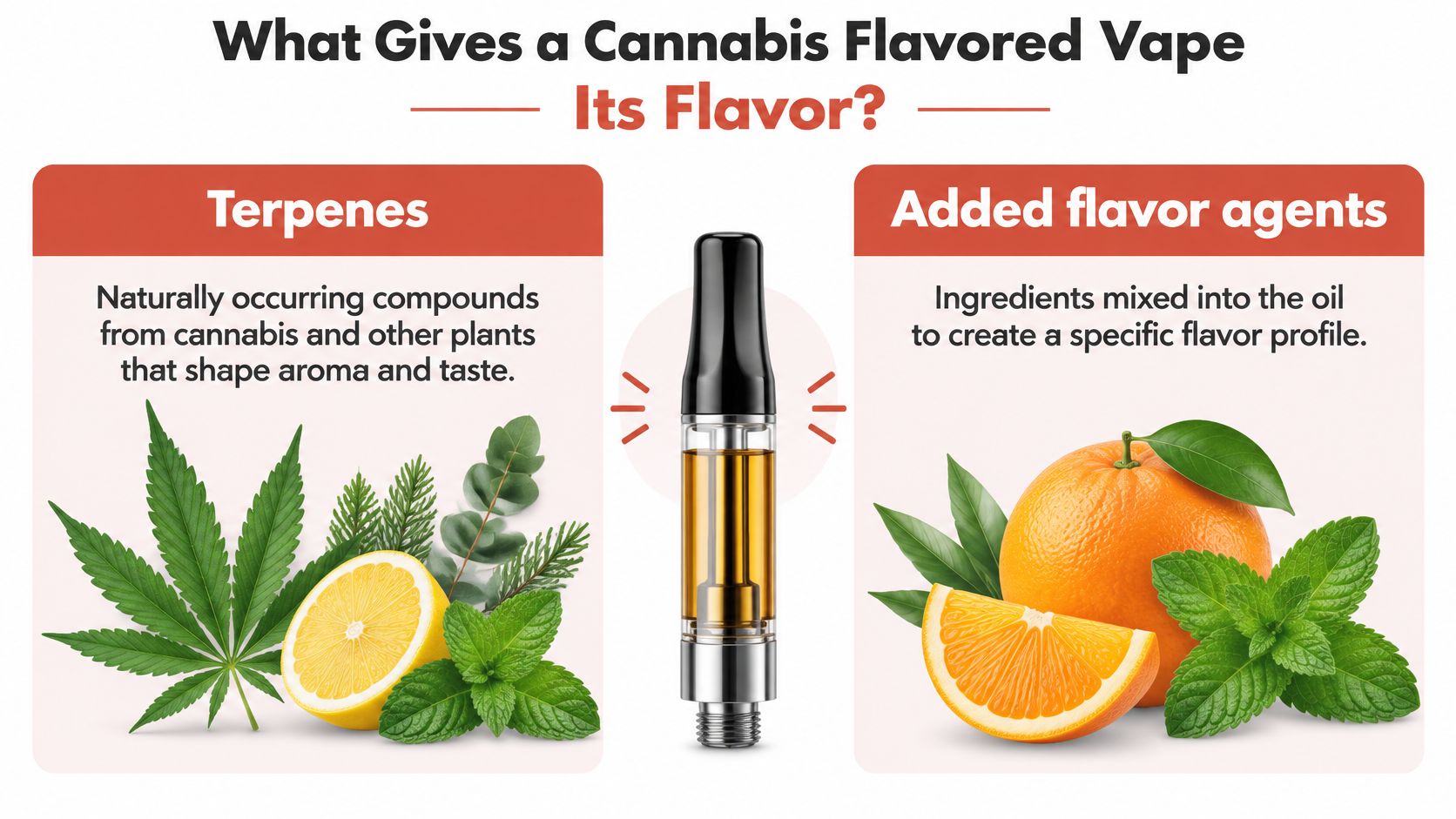
That distinction, plant-derived aroma versus an added system, is exactly what the comparison below is for. Read it as a set of questions you can put to any product page.
| Feature | Terpene-forward flavor | Added flavor agent |
|---|---|---|
| Origin | Aromatic compounds native to cannabis or other plants | Flavoring chemicals or blends added to the oil |
| How it is verified | Terpene identity and concentration in a batch lab report | Full ingredient list with batch-linked disclosure |
| Typical label wording | Strain name or listed terpene content | Flavor name only, such as mango or candy |
| What to request | Batch-specific terpene profile | Complete additive list and confirmation that additives are inhalation-grade |
Keep four attributes separate in your mind. Flavor intensity, terpene identity, cannabinoid potency, and cultivation quality are not the same thing. A loud smell can come from a heavy terpene loading or a strong added blend. It doesn't prove high potency, clean cultivation, or a careful extraction.
Stronger flavor doesn't mean higher quality. It means you have more reason to ask what created that flavor.
Before you buy any cannabis flavored vape, make one check. Ask for a batch-linked terpene profile and a full additive list for that specific lot. If the seller can show both, you can start judging the flavor claim. If they can't, treat the flavor name as marketing language and move on.
Use a simple reading method when a product page describes a flavor as citrus, pine, or lavender. Find the terpene list and ask whether that description is plausible. If you want the basics first, our guide to what terpenes in weed actually are explains where these compounds come from and why cultivars smell different from each other.
The table below covers seven terpenes you'll see often. It gives each one's typical aroma, the flavor words sellers tend to use for it, and the kinds of cultivars where it's often found.
| Terpene | Typical aroma | Flavor descriptors | Often found in |
|---|---|---|---|
| Myrcene | Earthy and musky | Mango, clove, herbal | Mango-scented and earthy cultivars |
| Limonene | Citrus | Lemon, orange, fresh peel | Citrus-scented cultivars |
| Terpinolene | Floral, herbal and piney | Fresh, floral, slightly sweet | Sativa-leaning cultivars |
| Pinene | Pine and fresh air | Pine, sharp, herbal | Pine-scented cultivars |
| Linalool | Floral | Lavender, sweet floral | Lavender-scented blends |
| Caryophyllene | Spicy and peppery | Black pepper, clove, warm spice | Spicy and woody blends |
| Humulene | Woody and earthy | Woody, hoppy | Hoppy and earthy cultivars |
If limonene is the top terpene by concentration, a bright citrus description makes sense. You'd expect lemon or orange peel up front, not heavy earth. If caryophyllene and humulene lead the list instead, peppery and woody is the plausible direction, and a sweet candy name should make you ask where that sweetness is coming from.
Don't read the whole list as if every compound matters equally. Trace amounts at the bottom rarely drive what you taste.
Reading rule. Look at the top two or three terpenes by concentration. They do most of the work in the aroma you actually notice.
A matching profile is a useful sanity check, not proof that a flavor is natural. Added flavor agents can imitate citrus, pine, or lavender closely enough that your nose can't tell the difference. That's why the terpene list needs the ingredient list beside it.
Ask three questions before you trust any flavor name:
Heat is where flavor stops being a label question. When a cartridge heats the oil, terpenes can oxidize, which means they react and break into new compounds during heating. Those new compounds, not just the original terpenes, enter the aerosol, the fine cloud you inhale.
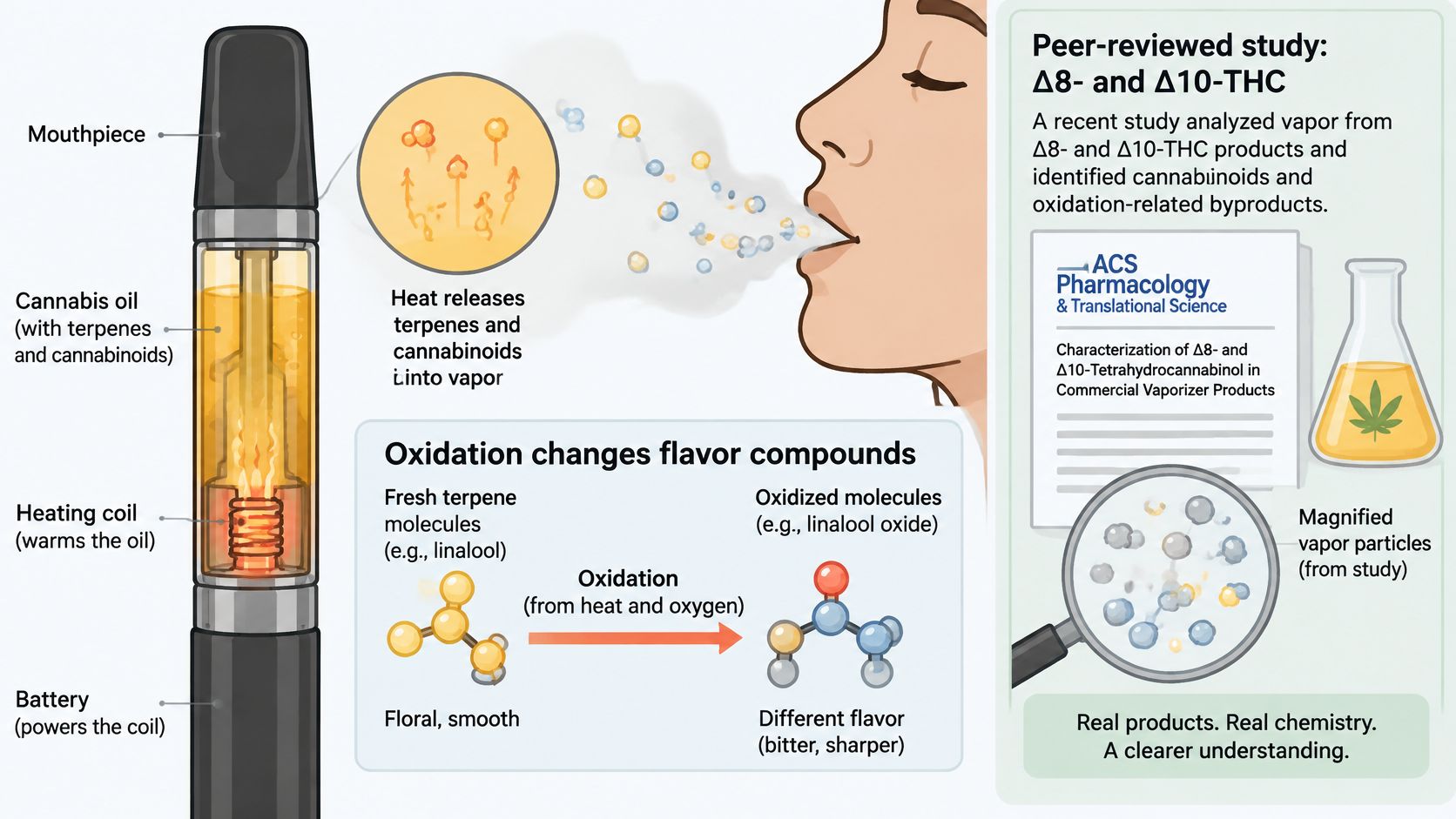
In a peer-reviewed study described in ACS Publications research on THC distillate emissions, adding a commercial terpene blend at 7.5% and 15% by mass to Δ8- and Δ10-THC distillates increased measured carbonyl emissions by as much as ninefold. Carbonyls are a family of compounds that includes aldehydes and ketones. The prominent products included acetone, acetaldehyde, and propionaldehyde, and most carbonyls originated from terpene oxidation during heating.
A separate thermal-desorption GC-MS study covered in the same source vaped THC and β-myrcene mixtures. It generated isoprene, 2-methyl-2-butene, 3-methylcrotonaldehyde, and 3-methyl-1-butene, together accounting for approximately 18 to 30% of the aerosol gas phase, with concentrations strongly correlated with applied power. More power meant more of these breakdown products.
The flavor you notice in the liquid isn't the full picture. Judge a cannabis flavored vape at its actual operating temperature and terpene concentration, not only by testing the unheated oil. Our explainer on the best temperature for vaping walks through how settings change taste and harshness in everyday use.
Lower-power, temperature-controlled hardware and restrained terpene loading can reduce thermal oxidation risk. They don't establish that vaping is safe, and you shouldn't read them that way.
Make two checks. Find the device's power or temperature setting and whether you can lower it. Then check whether the brand states its operating conditions at all. A seller who won't name a range is asking you to guess at the chemistry.
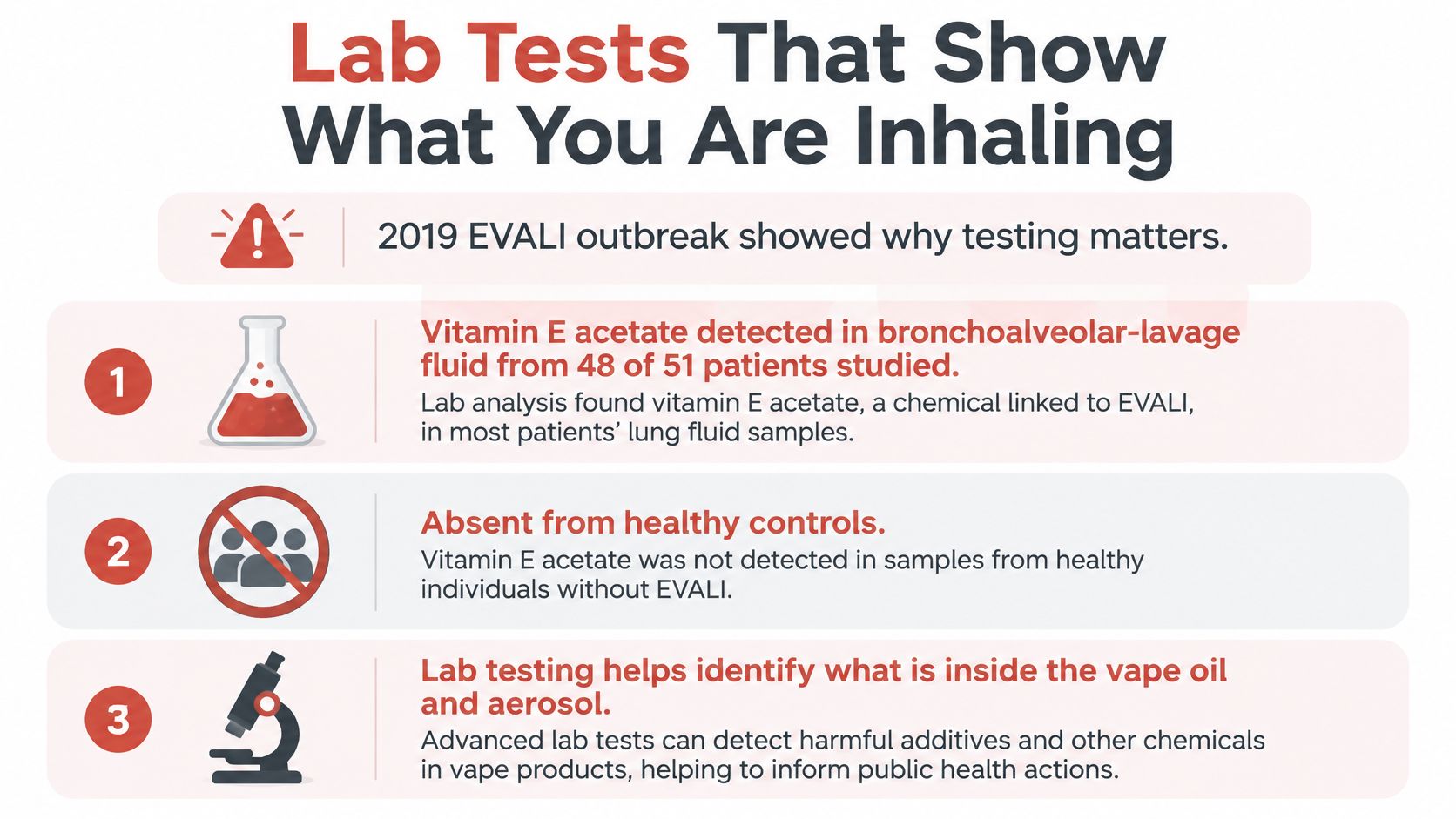
Testing matters because a label can't show you invisible additives. During the 2019 EVALI outbreak, the CDC investigation summary on vitamin E acetate reported that vitamin E acetate was detected in bronchoalveolar-lavage fluid from 48 of 51 patients studied, while it was absent from healthy comparators, and 94% of the cases also had evidence of THC exposure. Bronchoalveolar-lavage fluid is fluid collected from the lungs during a medical procedure. CDC investigations concluded that THC products containing vitamin E acetate, particularly products from informal or illicit sources, were strongly associated with EVALI, while noting that other toxicants could also contribute.
A certificate of analysis, often shortened to COA, is the lab report for a specific lot. If you're new to these documents, our walkthrough on how to read a certificate of analysis shows where the lot number, methods, and pass or fail results usually sit. For a flavored product you inhale, a lot-specific report should cover the categories below.
| Test | What it detects | Why it matters |
|---|---|---|
| Cannabinoid and terpene potency | Identity and concentration of THC, CBD and terpenes | Confirms the flavor source and the dose |
| Vitamin E acetate | Thinning agent linked to the EVALI outbreak | Should be absent from inhaled products |
| Pesticides | Agricultural chemical residues | Can be harmful when inhaled and heated |
| Residual solvents | Leftover extraction solvents | Residue can enter the aerosol |
| Heavy metals | Metals from soil, hardware or processing | Can accumulate with repeated use |
| Microbial contamination | Mold and bacteria | Creates a risk for inhaled products |
| Aerosol carbonyl screening | Aldehydes and ketones formed when heated | Shows what forms under real operating conditions |
Read each row with one question in mind. Does this test detect something in the oil before use, or something that forms once the oil is heated? Potency, pesticides, solvents, metals, and microbes describe what's already in the product. Aerosol carbonyl screening is different because it looks at what heating creates, which is why oil and hardware ideally get tested together under standardized puffing conditions.
Hold onto one rule. A potency certificate alone does not show that every flavor additive is suitable for inhalation. A report can confirm THC and CBD numbers perfectly and still leave you guessing about diluents, added agents, and contaminants. The report has to name the additives and show their test results.
A clean claim without named test methods is just a claim. The methods are what let you judge the result.
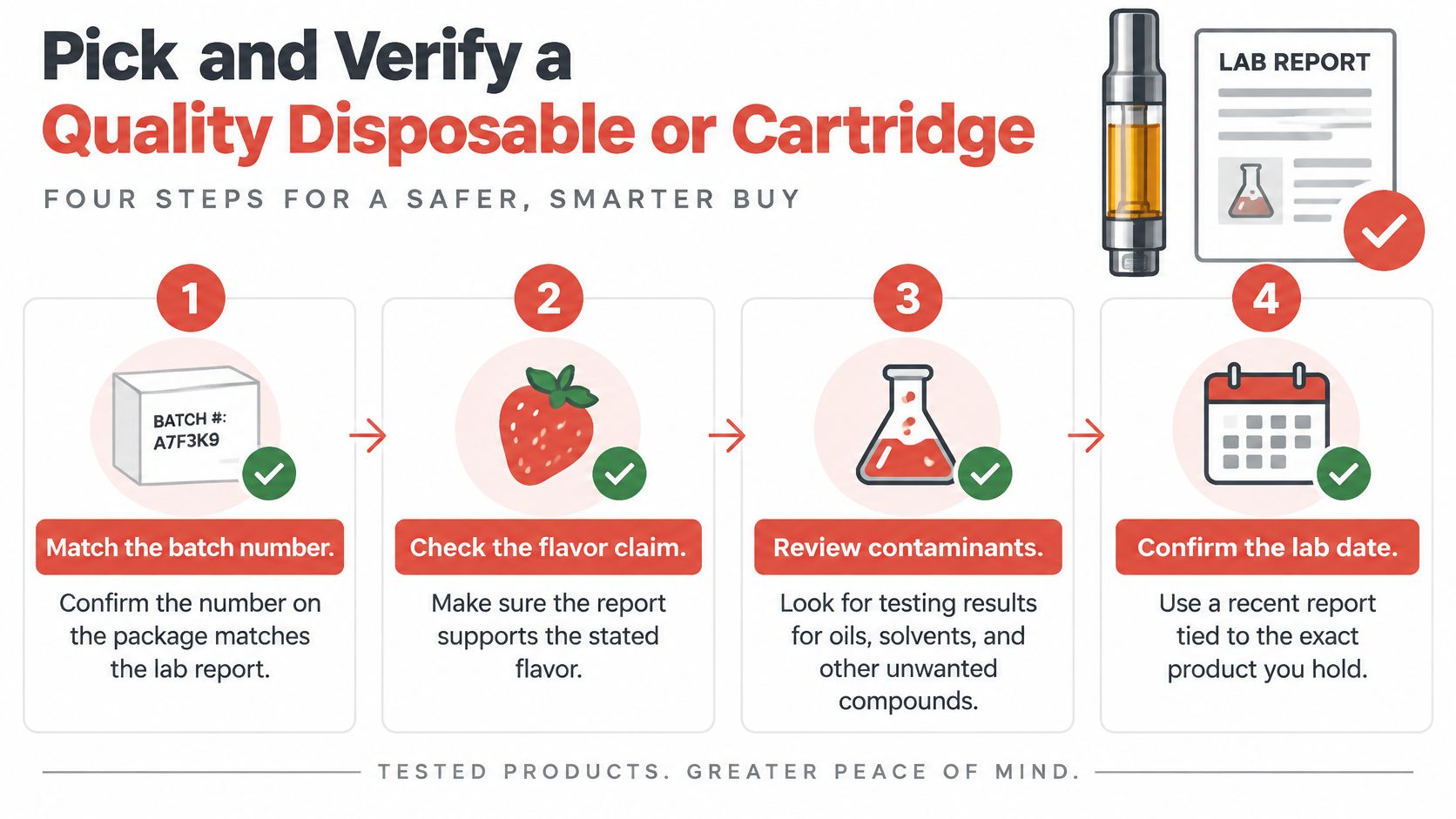
Find three items before you trust a report. Look for a lot number that matches the packaging, named test methods, and a clear ingredient list. If any one of those is missing, the document you've been given may describe a different batch, a different method, or a different product than the one you're about to inhale.
Flavored vapes sit close to younger buyers, which is why age controls carry real weight here. The National Institute on Drug Abuse Monitoring the Future release reported that 21% of adults aged 19 to 30 reported past-year marijuana vaping in 2022, compared with 12% in 2017. That is a legally adult but relatively young group, and it's where reported use is highest.
The concern extends below legal age. Among eighth-grade students who vaped marijuana, flavored-vape use increased from 47% in 2021 to 63% in 2024, according to the University of Michigan Monitoring the Future study reported by Bridge Michigan. Among 10th-grade students who vaped marijuana, flavored-vape use rose from 41% in 2021 to 53% in 2024, according to the Monitoring the Future findings in PMC. Flavor names like candy and fruit are designed to appeal, so sellers and buyers both have to treat access seriously.
Don't rely on a product page to tell you what's legal where you live. State rules differ widely and change often, so confirm the current law in your own location.
A compliant seller should make these points easy to verify, not bury them. Legal documentation and lab documentation tend to travel together. If a retailer is vague about age, shipping, or product category, that vagueness usually shows up in its testing paperwork too.
Make one decision before anything else. Don't buy a cannabis flavored vape until you've confirmed that the exact batch in your hand has a lab report that matches its flavor claim. Everything below follows from that decision, in the order you'd use it at a counter or on a product page.
Some warning signs are simple enough to spot in seconds:
The matched lab report is the one check that connects the flavor you taste to the substances you inhale.
Once you've bought, start on the lowest power setting your device offers. Take a small pull, wait, and note any change in taste or throat irritation as you go. A flavor that turns sharp, burnt, or chemical as the device heats up is information, and it's a reason to stop and reconsider rather than push through.
Be clear about what this process can and can't do. No checklist proves a product is safe to inhale, and anyone who promises you that is overselling. What these checks do is remove unknowns, one at a time, so the decision you're making rests on evidence you can point to instead of a flavor name you can't verify. Fewer unknowns is an honest goal. For a cannabis flavored vape, it's also the most useful one you've got.
If you want flavor claims you can verify, browse our strain-specific disposables and THCA flower at Melt, where each product page points you to its lab reporting so you can match the batch before you buy. Start with the terpene profile that fits the taste you're after, run the six checks above, and buy only when the paperwork lines up with the cartridge in your hand.
Your cart is currently empty.