


Free Shipping All Orders Over $95
Black Lime recorded 8.8% of flower-bud dry weight as total terpenoids, the highest total in a 2019 comparison of cannabis cultivars. A separate 2025 comparison instead led with Hindu Kush at 85.3 µg/g, so there's no single world champion across studies.
That second sentence is where most shoppers get tripped up. If you're asking what strain has the most terpenes, you're probably hoping for one name you can buy again and again. A strain name doesn't work that way. It's closer to a recipe title than a finished dish. Two cooks can follow the same recipe and plate very different results, and two growers can harvest the same cultivar with different aroma, cure, and lab totals.
What you can trust is narrower and more useful. You can name the leader inside one study, using that study's plants, methods, and units. Then you can take that same discipline to a dispensary or online menu and compare batch-specific lab reports instead of famous labels. That's how you move from a headline number to a jar that smells loud when you open it.
Start with the number that drew readers here. In the 2019 peer-reviewed study of terpene-production gene networks in Plant Physiology, Black Lime reached 8.8% total terpenoids by flower-bud dry weight, the highest measured total among the tested cannabis cultivars. White Cookies and Terple followed at 4.8% each, so Black Lime wasn't edging out the field. It was nearly double the next group in that particular comparison.
Inside that Black Lime result, one compound did much of the heavy lifting. Beta-myrcene alone reached 4.3%, while limonene reached 0.9%, alpha-pinene was reported at approximately 2.0%, and beta-pinene at approximately 0.5%. Read that as a recipe, not just a total. A bud can hit a high sum because many compounds contribute, or because one dominant compound towers over the rest.
The rest of that study's ranking helps you see the spread. Valley Fire measured 3.8%, Cherry Chem 3.5%, Blackberry Kush 3.4%, and Canna Tsu 3.3%. Sour Diesel, a name many buyers associate with a loud nose, measured 1.8% under those analytical conditions, and Mama Thai measured 0.7%.
That gap teaches an important lesson. Reputation and measured total aren't the same thing. A cultivar can smell distinctive because of the compounds it contains, even when another cultivar produces a larger summed total in a lab comparison.
Practical rule: Treat Black Lime's 8.8% as the leader inside that 2019 set, not as a promise attached to every plant sold under that name.
The authors also cautioned that the total represented only compounds for which authentic analytical standards were available. In plain language, the lab could only add up what it could properly identify and calibrate against. Compounds outside that target list didn't enter the 8.8%, so the figure shouldn't be treated as a universal maximum for Black Lime.
A different cultivar comparison produced a different leader. Hindu Kush topped its sample set, and Cannatonic came next, but those results were reported in micrograms per gram of dry flower, not percent of dry weight. Keep that leaderboard separate. Mixing it into the 2019 ranking would create a false combined chart.
Highest measured terpene totals by study
| Study | Cultivar | Reported total | Unit | Standout compound |
|---|---|---|---|---|
| 2019 gene-network study | Black Lime | 8.8 | % of flower-bud dry weight | Beta-myrcene 4.3% |
| 2019 gene-network study | White Cookies | 4.8 | % of flower-bud dry weight | Total reported only |
| 2019 gene-network study | Terple | 4.8 | % of flower-bud dry weight | Total reported only |
| 2019 gene-network study | Valley Fire | 3.8 | % of flower-bud dry weight | Total reported only |
| 2019 gene-network study | Cherry Chem | 3.5 | % of flower-bud dry weight | Total reported only |
| 2019 gene-network study | Blackberry Kush | 3.4 | % of flower-bud dry weight | Total reported only |
| 2019 gene-network study | Canna Tsu | 3.3 | % of flower-bud dry weight | Total reported only |
| 2019 gene-network study | Sour Diesel | 1.8 | % of flower-bud dry weight | Total reported only |
| 2019 gene-network study | Mama Thai | 0.7 | % of flower-bud dry weight | Total reported only |
| 2025 cultivar comparison | Hindu Kush | 85.3 | µg/g dry flower | Myrcene 49.3% of profile; farnesene 4.1 µg/g |
| 2025 cultivar comparison | Cannatonic | 76.3 | µg/g dry flower | Sesquiterpenes 14.9 µg/g; alpha-humulene 2.9 µg/g |
So, what's the clean answer? Black Lime is the strongest answer when "most" means the highest total quantified terpenoid percentage in that 2019 scientific comparison. Genetics, cultivation, maturity, curing, and laboratory method can all move the result for the next plant, harvest, or jar.
The two headline numbers answer different measurement questions. Percent of dry weight tells you what share of the dried bud's mass the measured compounds made up. Micrograms per gram tells you the mass of measured compounds found in each gram of dry flower. You can't declare 8.8% "higher" than 85.3 µg/g without first confirming that both labs measured the same compounds, prepared samples the same way, and reported results on a convertible basis.
Think of two cooks arguing over the spiciest chili. One reports Scoville heat units. The other reports teaspoons of chili powder. Both numbers describe heat in a loose everyday sense, but they don't create one ranking until you know the ingredients, the serving size, and the measuring method.
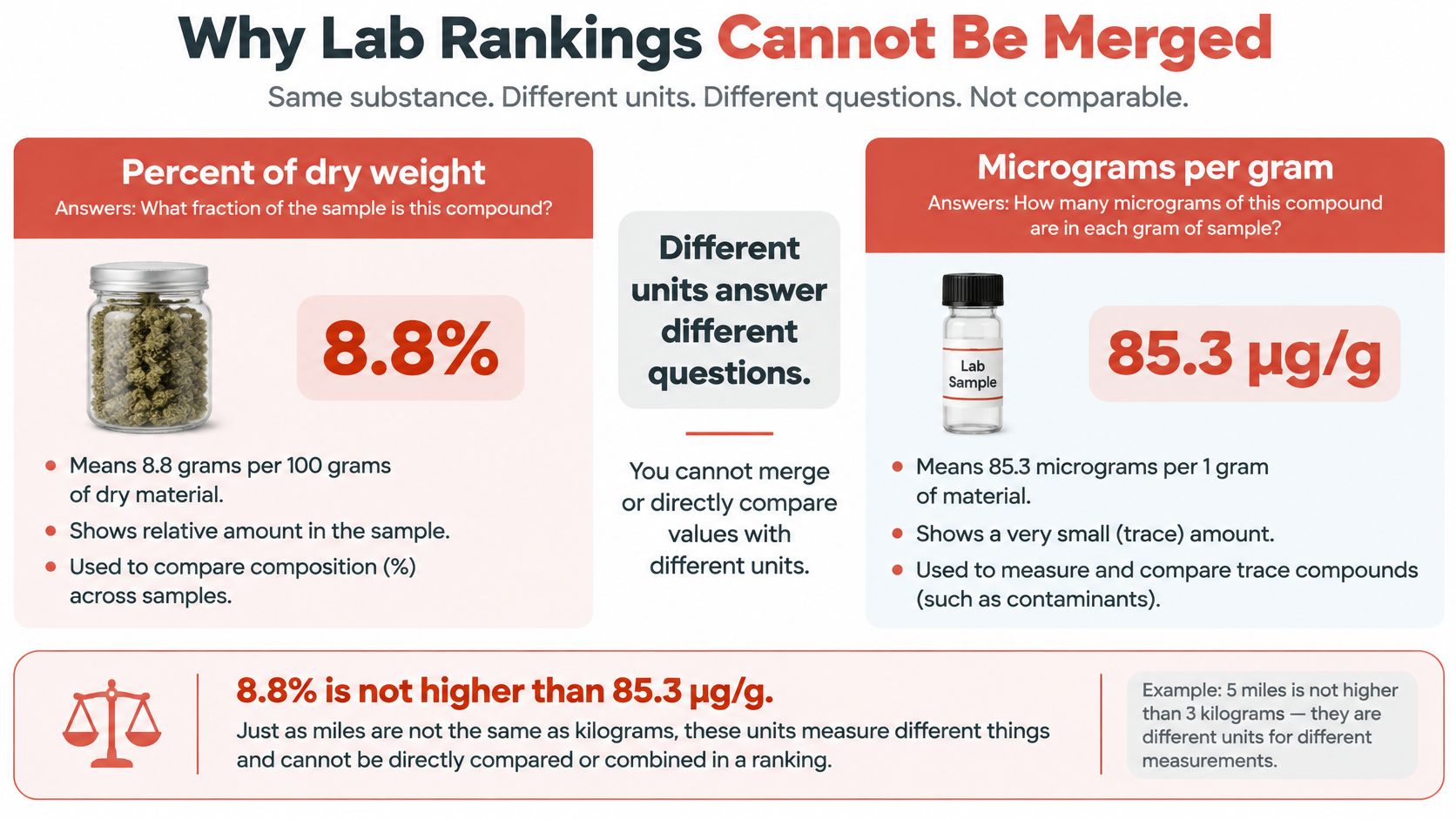
The 2025 cultivar comparison in Plant and Cell Physiology found Hindu Kush had the highest total terpene concentration among its samples at 85.3 micrograms per gram of dry flower, followed by Cannatonic at 76.3 micrograms per gram. Hindu Kush also led total monoterpenes at 70.4 micrograms per gram, while Cannatonic had the highest total sesquiterpene concentration at 14.9 micrograms per gram.
Those details matter because the studies didn't test identical lineups. A cultivar absent from one sample set can't win or lose that comparison. The 2025 work also split monoterpenes from sesquiterpenes, which changes how a reader interprets the total and which compounds appear important.
Analytical targets deserve special attention. If one lab quantifies a short list of common terpenes and another includes additional compounds, the second total may look larger partly because the net is wider. That's not cheating. It's a different measurement design, and it's why the printed total always needs its method and unit beside it.
A batch-specific third-party certificate of analysis, or COA, is more authoritative for a purchase than a cultivar name alone. You can compare two COAs fairly when they use the same reporting basis, such as percent with percent or mg/g with mg/g. If the units differ, pause before ranking anything.
This is also why a profile for one cultivar, such as a breakdown of Mimosa strain terpenes, should be read as information about that tested material rather than a permanent score for every harvest carrying the name. The name points you toward a likely family of aromas. The batch report tells you what the lab found in the product in front of you.
Squeeze a strip of lemon peel near your nose. That sharp burst comes from aromatic oils held in tiny structures in the peel, and crushing or warming the peel releases them. Cannabis flower works in a similar everyday way. Grinding or heating a bud releases scent that was already stored in the flower.
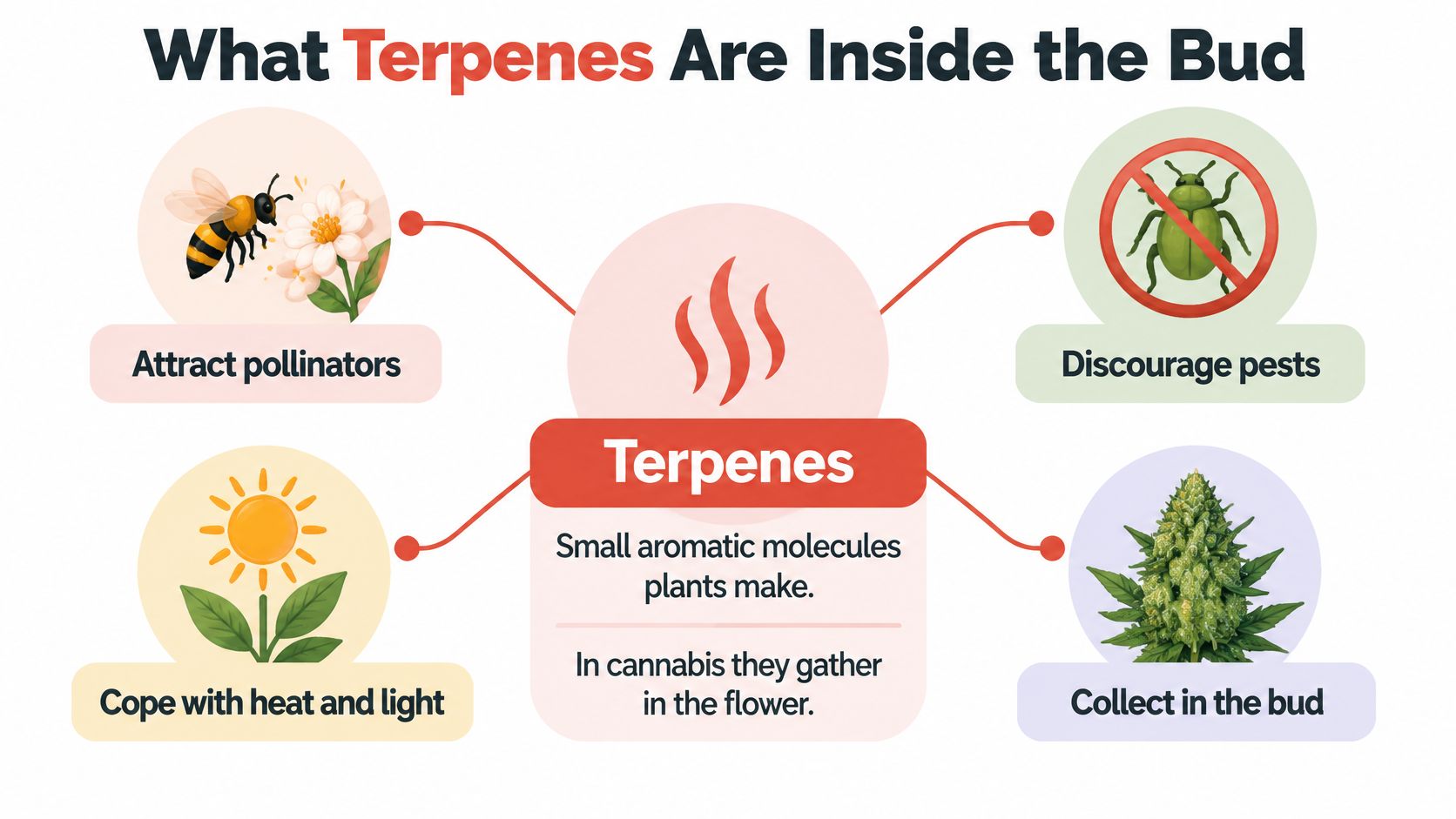
Terpenes are small aromatic molecules plants make for practical jobs. They can attract pollinators, discourage pests, and help the plant cope with heat and light. In cannabis, they collect in the resinous trichomes on the flower, the sticky glands that give good bud a frosted look. They are not cannabinoids, even though they share that resinous neighborhood.
For shopping, you only need two broad groups.
Say you open two jars with a friend. The first hits immediately with citrus and pine, then quiets down. The second starts softer but leaves a peppery, woody smell in the grinder. You may be noticing the difference between a profile led by lighter, faster-evaporating compounds and one with more staying power from heavier compounds.
A terpene profile is the recipe, meaning which compounds are present and in what proportions. Total terpenes is only the sum the lab chose to add up. Those are related, but they don't tell the same story.
A total tells you how much measured aroma chemistry the lab summed. A profile tells you what that aroma is likely to smell like.
Genetics set the range of compounds a plant can produce. Light, nutrients, harvest timing, drying, and curing then decide how much of that potential survives into the jar. A plant can have excellent genetics and still reach you muted if it's harvested at the wrong moment, dried harshly, or stored warm in a loose bag. That's why what strain has the most terpenes is only the beginning of the buying question, not the end of it.
The biggest line on a terpene panel usually explains your first impression. If one compound makes up close to half the measured profile, your nose will probably meet that compound's character first, even when smaller notes add complexity underneath.
Myrcene reads earthy, musky, and ripe, a bit like mango and damp herbs. When it dominates, flower often smells deep and herbal rather than bright. Limonene moves in the opposite direction, toward lemon zest and fresh citrus peel. Alpha-pinene and beta-pinene bring pine needles and resin, while beta-caryophyllene smells like black pepper and warm spice.
Common cannabis terpenes and how they smell
| Terpene | Typical aroma | Where it showed up in the research |
|---|---|---|
| Myrcene | Earthy, musky, ripe mango | 4.3% of Black Lime dry weight; 49.3% of Hindu Kush and 54.1% of Cannatonic profiles |
| Limonene | Bright citrus, lemon zest | 0.9% of Black Lime dry weight |
| Alpha-pinene | Sharp pine, fresh resin | About 2.0% of Black Lime dry weight |
| Beta-pinene | Dry pine, herbal | About 0.5% of Black Lime dry weight |
| Beta-caryophyllene | Black pepper, warm spice | A core compound to check on any COA |
| Ocimene | Sweet, herbal, slightly tropical | About 50 µg/g in one studied strain and undetectable in another |
| Humulene | Woody, hoppy | Cannatonic's alpha-humulene reached 2.9 µg/g |
| Farnesene | Green apple, soft floral | Hindu Kush reached 4.1 µg/g |
| Linalool | Lavender, soft floral | Often a minor note that changes the finish |
A missing compound is not automatically a lab error. Ocimene is a good example because a profile can show a clear amount in one cultivar and none detectable in another. Plants don't all carry the same aromatic toolkit, and a zero or "not detected" line can mean that cultivar doesn't express much of that compound, or that the amount fell below the lab's reporting limit.
Say one batch is led by myrcene with smaller floral notes. You'll likely describe it as mango, earth, and herbs. Another batch led by limonene and pinene may smell like lemon cleaner and a pine forest, even if its grand total is lower. Neither description tells you which one you'll enjoy more, but it does tell you which aroma family you're buying.
That's why you should read the top two or three compounds before you celebrate or dismiss the total. If you're learning the basics of how terpenes work, start with that short list at the top of the panel. It gives you a practical scent forecast without turning a smell into a guaranteed mood, medical use, or effect.
A COA looks intimidating because it's built for compliance as well as shopping. You don't need to understand every line. You need six checks, in order, each tied to something you can see on the PDF or product page.
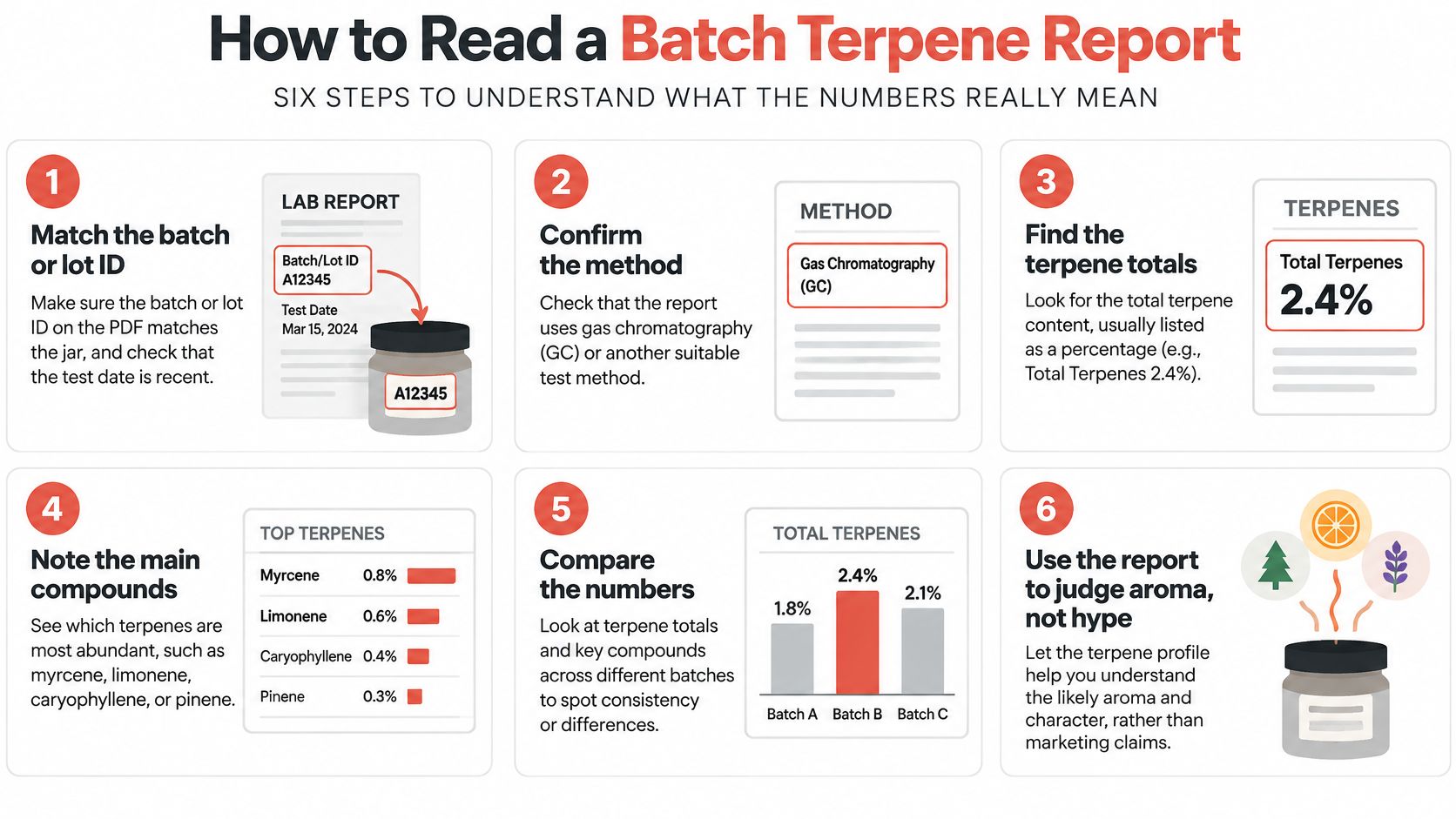
If you want a slower walkthrough of the document layout, Melt's guide on how to read a certificate of analysis follows the same batch-first logic. Use it beside the actual PDF, not instead of the PDF.
The controlled study of two Cannabis sativa strains indexed by ScienceDirect found one strain contained approximately 50 µg/g of (E)-β-ocimene, while the compound was below the detection limit in the other. Even plants of the same strain, grown under controlled conditions and harvested simultaneously, showed roughly 20% variability for terpenes present above 20 µg/g.
That variability is the technical reason a famous name can't guarantee the highest result. Reported totals also depend on sample preparation, calibration, detection limits, and whether acidic or volatile compounds are captured. Two honest labs can produce different totals because they aren't performing identical measurements.
The most terpene-rich purchase is the tested batch with the highest verified total on the same reporting basis, not necessarily the product with the most celebrated cultivar name.
Keep that sentence in your pocket at the counter. It protects you from paying a premium for reputation when a fresher, better-documented batch is sitting beside it.
A larger terpene number doesn't automatically mean a stronger, better, or more therapeutic session. That's the assumption to retire. A total can tell you that a batch contains more of the measured aromatic compounds, but it can't, by itself, predict how the flower will feel to you or whether you'll like the flavor.
The image below frames the problem as a leaderboard, which is exactly how many menus present it.
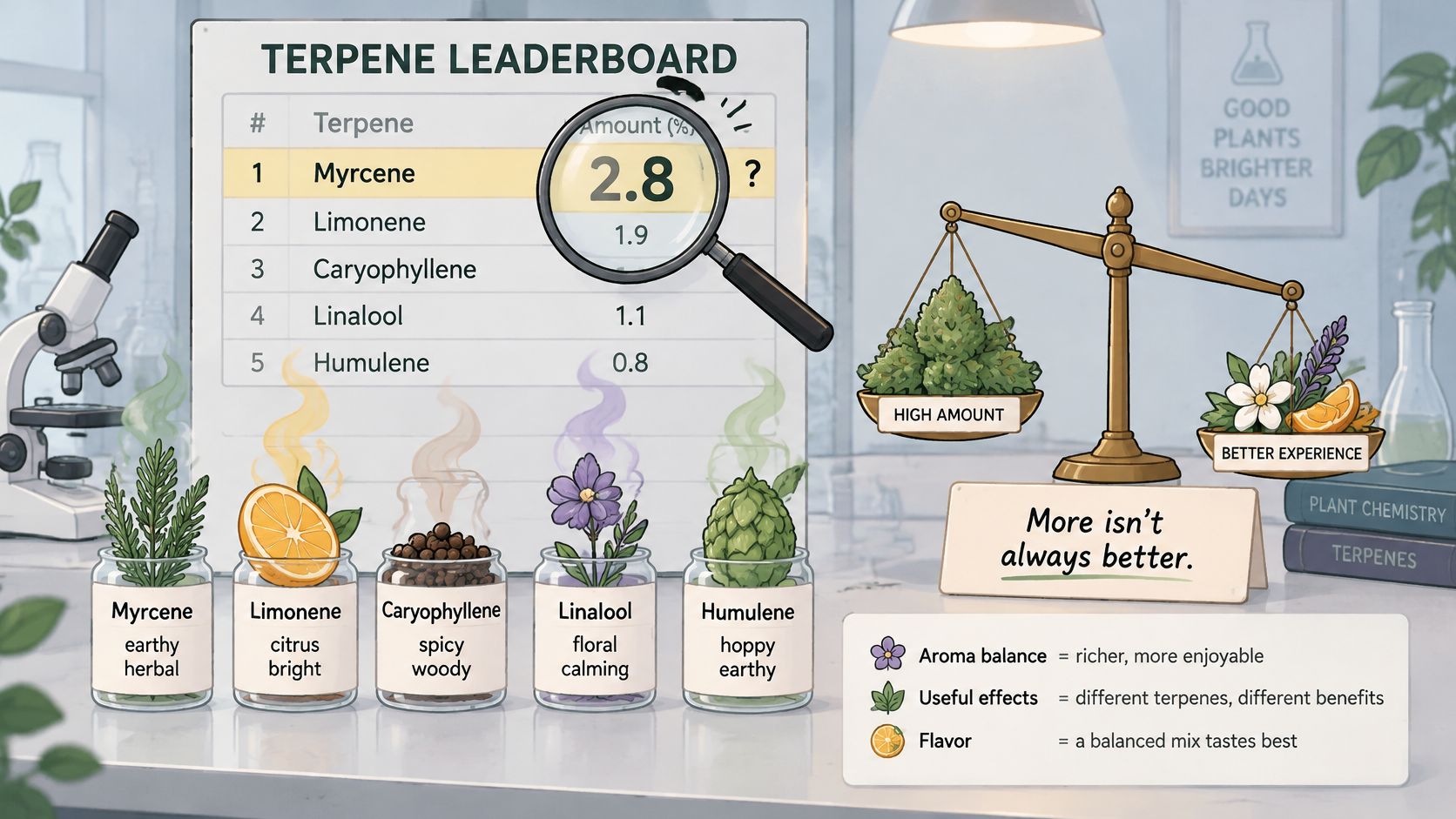
In the German-market study discussed in Cannabis and Cannabinoid Research, researchers detected 38 terpenes and found that nine compounds explained 86% of profile variation, while terpene profiles did not reliably correspond to presumed pharmacological effects or genetic labels. Human evidence for the frequently promoted "entourage effect" also remains limited, with preclinical cannabinoid and terpene interactions described but mechanistic demonstrations in humans lacking.
So a hypothetical bud at 3% total terpenes isn't predictably twice the experience of one at 1.5%. What changes more clearly is character. A limonene-bright profile, a peppery caryophyllene profile, a myrcene-heavy profile, and a linalool-floral profile can smell and taste different even when their totals are close.
The short video below is a useful pause before you turn those aroma families into effect promises.
Postharvest handling adds another gap between paper and jar. Research on hemp flower reports that drying methods can materially affect terpene levels, with cultivar-dependent differences in stability. A high result measured near harvest can fade after a hot cure, rough handling, or months in warm storage.
Ask three better questions than "which total wins." Which two compounds dominate? How recent is the test? Does the flower still smell like that profile when the jar opens? If the nose is flat while the report looks spectacular, trust the mismatch as a warning and choose a fresher batch.
Turn the research into one purchase rule you can use as an adult buyer. Discard any option whose report is undated, generic, or tied to another lot. Among the batches that pass, compare totals only when the units match, then read the top two or three compounds to choose the aroma you want.
Product names can still help you explore flavor families if you treat them as starting points. For example, our Lemon Tree Hybrid THCA Flower has a THCA content of 34.91%, is a hybrid, and has flavor notes of citrus, diesel, and bright lemon zest, while Rainbow Runtz (Hybrid) has a rich terpene flavor with consistent potency. Every strain ships with a third-party Certificate of Analysis covering potency, pesticides, heavy metals, and Δ9-THC compliance, so you can apply the same batch checks to our flower that you'd apply anywhere else.
Your final action is simple. Open the certificate for the exact batch, confirm the unit, read the dominant compounds, then smell the flower before you buy when the retailer allows it. That's a more reliable answer to what strain has the most terpenes than any permanent leaderboard can give you.
Shop by the batch report, not by hype, and use the dominant terpene lines to pick the citrus, pine, pepper, or earth profile you want. Melt publishes third-party Certificates of Analysis for its flower so you can check potency and compliance alongside the product details before you order. Visit Melt to review the current lineup and choose your next jar with the lab paperwork in hand.
Your cart is currently empty.