


Free Shipping All Orders Over $95
Caps pre rolls are not one standardized product, the words can mean a mouthpiece tip, a brand line, or a larger hash-infused pack such as two 2-gram joints advertised near 30% THCA. That advertised percentage is not a batch certificate, and it does not tell you what you'll feel after heat does its work.
That challenges the most popular shopping advice you'll hear, which is to buy the highest percentage and trust the strain name. Don't. A percentage can be a starting clue, but it can't confirm what you are holding, how evenly it will burn, or whether the pouch in your hand matches any test result.
Shop in a different order. First identify which meaning of Caps pre rolls is for sale. Then translate the chemistry, check the physical build, and pick a size that fits the session you want.
Caps pre rolls sound specific, so shoppers often assume there's one recipe, one size, and one expected strength. There isn't. The same words get used for a part of a joint, a commercial product line, a style of infusion, and sometimes a local menu nickname.
Treat the name like a label on a shelf, not a formulation. Two stores can use it for products that differ in weight, flower source, added hash, tip design, and potency. A third store may use Caps for a cultivar name that says nothing about infusion at all.
A literal cap is the mouthpiece or filter tip built into a cone. Think of the tip of a straw that also blocks crumbs. It keeps loose flower off your lips, gives the paper end more firmness, helps steady airflow, and puts some distance between your mouth and the hot end as the joint gets short.
That cap helps with draw and handling. It doesn't create potency, fix wet flower, or make a loosely packed cone burn straight. If a seller talks about the tip as if it's an ingredient, you're already hearing marketing rather than product information.
A second meaning is commercial. The Waterbeds 'n' Stuff listing for CAPS by Good Morels describes a resealable two-pack containing two 2-gram hash-infused joints, with advertised potency of approximately 30% THCA. That adds up to 4 grams per pouch and roughly 1,200 mg of THCA-equivalent content before accounting for conversion, combustion loss, or the distinction between labeled THCA and active THC.
Read that number carefully. It's a retailer description, not a government laboratory record, so it shouldn't be treated as independently verified potency data. The format still matters because a 2-gram infused joint is a very different purchase from a traditional half-gram or one-gram joint. The larger unit is built around convenience, infusion, and a longer session, not a quick sample.
Name your row in the table before you judge quality. A tip, a brand, an infusion style, and a nickname need different checks.
| Meaning | What you are holding | Typical size or claim | Check first |
|---|---|---|---|
| Mouthpiece or filter cap | Cone with a tip that keeps flower off the lips and steadies airflow | Tip inside a standard single or multi-pack cone | Tip fit, paper, and an even pack |
| Brand or product line | A named line such as CAPS by Good Morels, often hash-infused | Resealable two-pack of two 2 g joints, about 30% THCA advertised, about 4 g and roughly 1,200 mg THCA-equivalent | Lot-matched COA, not the product page |
| Infused or hash-centered joint | Flower plus hash, kief, or concentrate sold as a convenience unit | Larger than a traditional half-gram joint | Whether infusion is listed apart from flower THCA |
| Cultivar or SKU nickname | A strain or menu name called Caps, not a shared formula | Size and claim set by that retailer's specific SKU | Do not assume potency or infusion from the name |
Once you know the row, stop asking what Caps usually means. Ask what this pouch contains, which lot it came from, and whether heat will turn its raw label into a much stronger session than you planned.
Start with one picture. THCA in raw flower is like a locked bottle. Heat from a flame, vaporizer, or oven removes the acid group and opens it, releasing delta-9 THC, the compound that interacts with CB1 receptors and drives euphoria, relaxation, appetite, and impairment.
That means the raw label describes the locked bottle, not the opened one. A product can look mild if you only read pre-heat delta-9 THC, then feel strong once you light it. The chemistry is not a trick added by the seller. It's what smoking does.
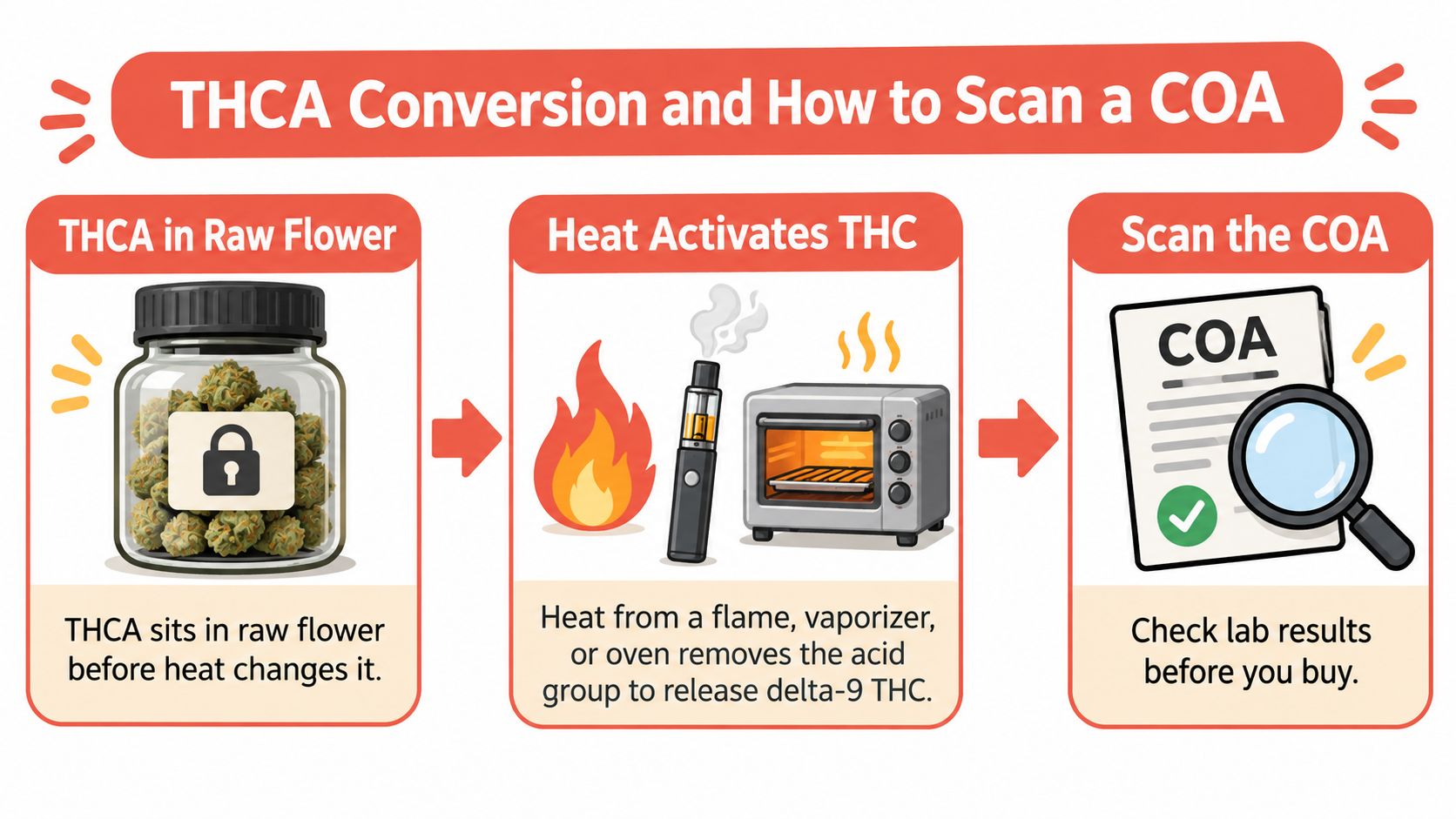
Many consumer explanations describe THCA pre-rolls as compliant when raw delta-9 THC is below 0.3%, and the California standard test methods document shows why the laboratory method behind that number matters because California's regulatory testing framework requires laboratories to use an HPLC cannabinoid method for dried flower, including non-infused pre-rolls. Compliance language answers a legal and testing question. It doesn't answer the session question, because smoking or vaporization converts THCA into psychoactive delta-9 THC.
For planning, total THC is closer than raw delta-9 alone. Total THC is an estimate that accounts for THCA conversion, so on THCA-rich flower it should be meaningfully higher than the delta-9 line by itself. If a page highlights a tiny delta-9 number and hides a high THCA number, it's telling the compliance story while skipping the effect story.
Don't assume hemp status cancels intoxication. It doesn't remove impairment, and it doesn't make driving safe. Plan from total THC, joint weight, infusion, and your own tolerance.
Say a label claims 30% THCA on a 2-gram joint. The simple math is about 600 mg of THCA in that joint. That's not 600 mg of THC delivered into you.
Several things reduce and blur that number. Total THC involves a conversion estimate, labs work with measurement uncertainty, combustion is incomplete, and some smoke escapes between draws. Cannabinoids also may not be distributed uniformly from tip to end, especially when hash or another concentrate is added in one place rather than dispersed evenly.
Use the percentage for comparison and caution, not as a dose promise. A high-THCA infused joint deserves a shorter first session, slower pacing, and a hard stop if the effect arrives faster than expected. You can read more about the distinction in our guide to THCA percentage versus THC percentage, but the COA for your exact lot still matters more than any general explainer.
Planning rule: Read delta-9 for the raw product, total THC for the likely post-heat direction, and joint weight for how much material is available to convert.
A certificate of analysis, or COA, is useful only when it belongs to the pack you're buying. Start at the top and work down. Don't jump straight to the biggest percentage.
Sampling tells you how the result was produced. The New York Office of Cannabis Management testing limits document states that final products, including raw pre-roll categories, require testing and that five samples must be tested per product batch or lot regardless of batch size. That's a useful benchmark even outside that framework because it shows the difference between a defined lot system and a seller posting one attractive number with no traceable batch.
Keep your scan to fields that answer a real buying question. Is this the right lot? Is the test current? What converts when heated? What else was screened?
| Field | What it tells you | Usable signal |
|---|---|---|
| Lot or batch number | Ties this pouch to this test | Matches the package exactly |
| Test date and method | Whether the report is current and comparable | Recent date, HPLC for dried flower and non-infused pre-rolls under California's method rules |
| THCA | Acidic cannabinoid before heat | Percentage, usually dry-weight, not a milligram dose |
| Delta-9 THC | THC already active before lighting | Hemp labels often at or below 0.3% pre-combustion |
| Total THC | Estimate after conversion | Meaningfully higher than delta-9 alone on THCA-rich flower |
| Contaminant panel | Solvents, heavy metals, pesticides, microbes | Panel present and within the stated limits |
| Sampling | How much of the lot was actually tested | New York requires five samples per product batch or lot regardless of batch size |
If the lot doesn't match, the dates are missing, cannabinoids are blended into one number, or the contaminant panel is absent, treat the percentage as marketing. Walk away or choose another pack. A strain name can't repair missing evidence.
Also remember what a COA can't do. It can't promise every draw tastes the same, every joint burns evenly, or two people will feel identical effects. It gives you a tested estimate for a lot, which is far better than guessing from a name.
A strong COA won't save a joint that canoes down one side. Burn quality comes from moisture, grind, packing density, paper, airflow, and how the cherry moves through the cone. Those physical details explain why two products with similar labels can smoke very differently.
The Cannabis Science and Technology smokability study found that pre-rolls stabilized at 0.65 water activity produced the highest cannabinoid concentrations in smoke, with 0.45 performing similarly, while material at 0.85 delivered only about 30% of the cannabinoid concentration measured at 0.65. The same study found that combustion effectively decarboxylated acidic cannabinoids, flower contained predominantly acidic forms such as CBDA, and smoke showed no significant acidic cannabinoids.
| Water activity | Cannabinoids in smoke | What the session feels like |
|---|---|---|
| 0.45 | Similar to 0.65 in the study | Dry end of the favorable band, burn speed and harshness were not measured, so check a sample |
| 0.65 | Highest cannabinoid concentration measured | Balanced release and burn in the study's favorable band |
| 0.85 | About 30% of the 0.65 concentration | Suppressed delivery, a wet and uneven cherry is a likely sign, not a measured result |
You probably don't own a water-activity meter, and you don't need one to reject obvious problems. A useful joint feels firm and even along its length, without a loose neck near the tip or a hard plug that blocks the draw. The seated cap shouldn't spin freely or slide out when you handle the cone.
Flower that crumbles to dust points toward a fast, harsh burn. Flower that clumps and feels spongy can make the cherry struggle and taste steamy. Neither squeeze test replaces manufacturing records, but both tell you more about the next ten minutes than a flavor name does.
Grind matters because uneven particles create uneven air paths. Fine dust can pack too tightly, chunky pieces can leave channels, and either problem can send heat racing along one side. If you roll your own for comparison, our notes on how to grind flower evenly cover the texture you're aiming for.
Terpene words also need context. Aroma comes from flower that was cured, stored, and packed to protect volatile compounds. Printing a dessert or fruit name on the pouch doesn't prove those compounds survived. Ask for batch burn tests and water-activity records when a seller claims premium consistency.
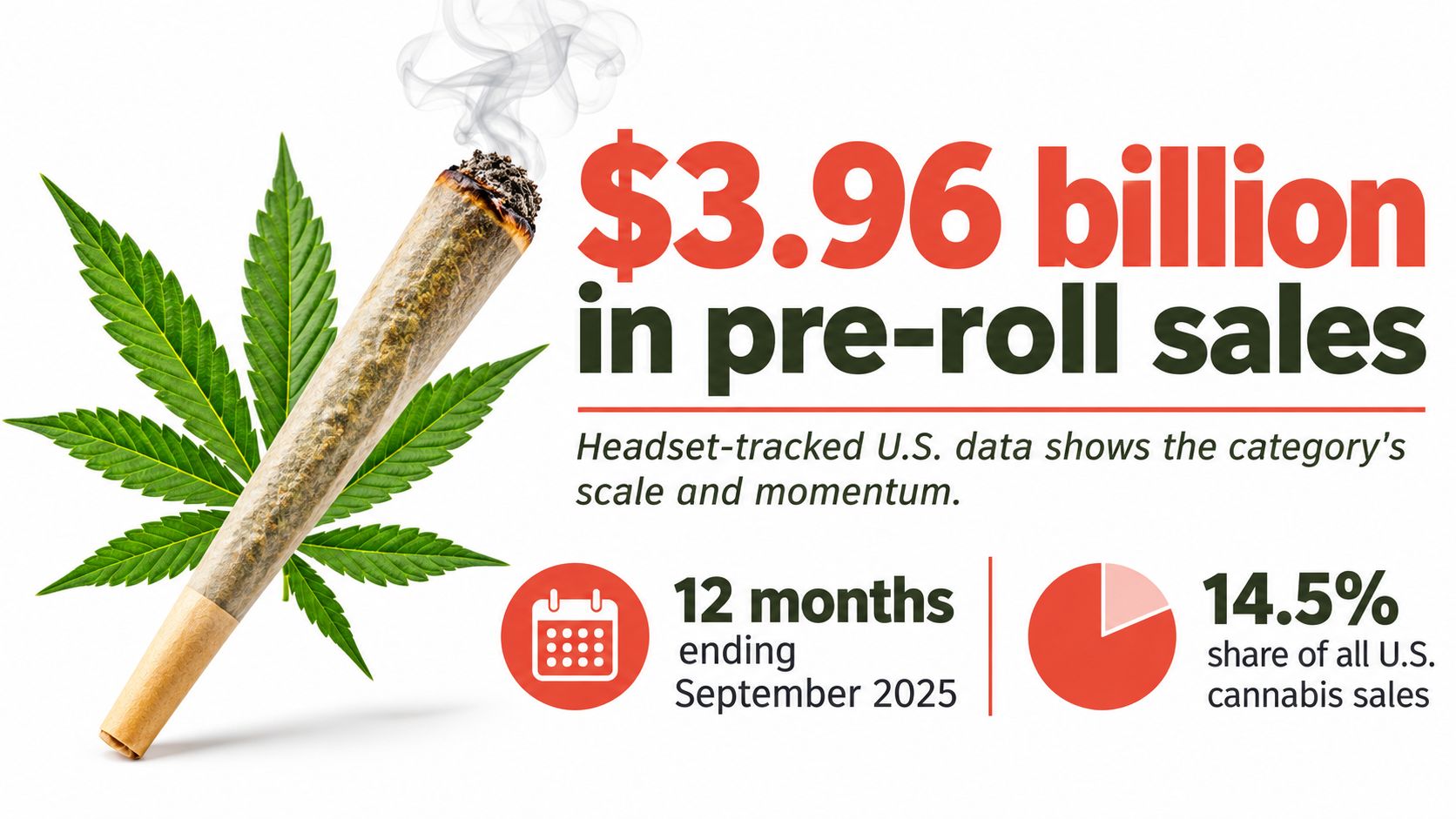
Large infused cones can look like novelty products until you see the category around them. The Herby Bud summary of pre-roll statistics reported Headset-tracked U.S. data of $3.96 billion in pre-roll sales during the 12 months ending September 2026, representing 16.1% of tracked cannabis dollars and 10.7% year-over-year growth. Those future-dated tracker figures should be read as the source's reported measurement for that stated period, not as an official federal census.
A separate 2025 estimate in that summary cited 383.2 million pre-roll units sold, approximately $3.6 billion in sales, a 15.9% share of tracked dollars, and 18.6% unit growth. Infused products accounted for $1.67 billion in infused pre-roll sales and 144.5 million units in 2025. Use the figures for one point only. Convenience, infusion, and pack size are mainstream ways brands compete.
The chart below puts that scale in visual form before you compare individual formats.
A 0.5 g single suits a short trial or a lower-commitment session. It's the easiest format for learning a cultivar without storing a half-smoked joint. The tradeoff is less value per gram and less time to judge burn quality.
A 1 g classic cone is the familiar middle ground. It gives you a fuller session and enough length to notice whether the pack stays even. For many buyers, it's also easier to pace than a large infused product.
A 1.5 g hand-packed cone is built to burn longer. Size alone won't make it smooth, so packing and airflow become more important as the cone gets bigger. A 2 g hash-infused joint moves into premium pouch territory, where the added concentrate can raise intensity and make distribution quality more noticeable.
This short video gives a useful visual reference for how format and handling change the experience.
Infusion isn't automatically better. Choose it when you want a heavier hit and the seller explains what's added, not when you want flower flavor for longer. A filter cap can improve handling on any size, but it can't correct lumpy hash, poor grind, or a cone packed tightly at one end and loose at the other.
Good storage protects the burn you paid for. Keep it simple, dry, and sealed, and don't chase elaborate setups that add moisture problems.
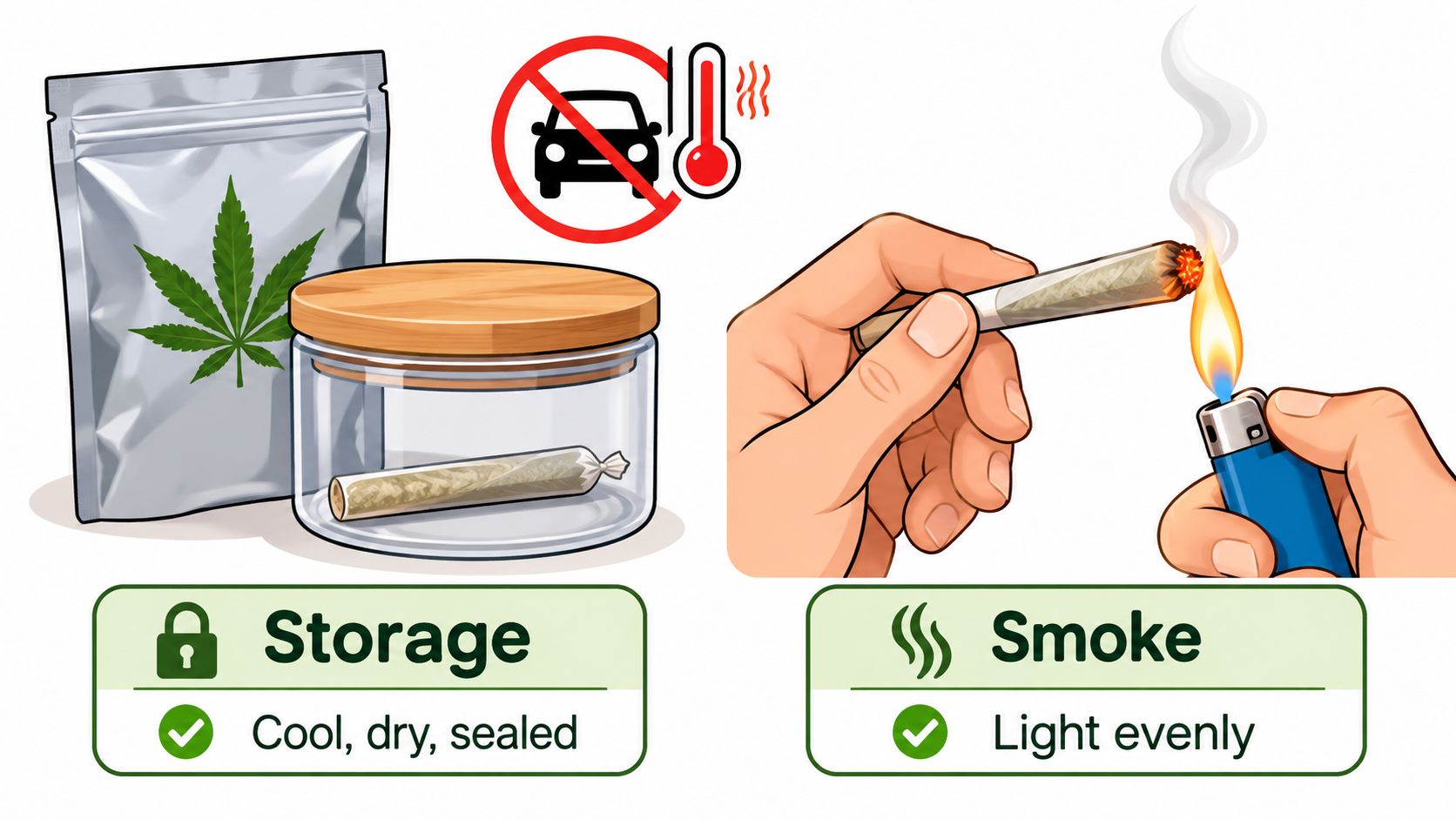
Our guide on how long pre-rolls last can help you judge freshness, but smell, texture, and a clean draw still deserve a quick check before lighting.
A slow, even burn is the point. Relighting a rescued half later is normal, especially with a large infused cone.
Don't treat a 1.5 g or 2 g infused joint like a one-puff sample. Pause between draws, notice the effect, and stop while the session still feels manageable.
Buy in the same order every time. Format first, value second, evidence before checkout.
Apply those checks to us as well. We make Melt Exotic Prerolls hand-packed with THCA indoor flower and strain-specific terpenes, and every Melt Exotic Preroll is tested by a third party for cannabinoid potency, residual solvents, heavy metals and pesticides. Our Melt Duo pack contains 20 prerolls of 1.5g each, with no grinder or papers needed, but the pack size is only a good fit if that session length and the lot result suit you.
Don't let ratings replace records. A popular flavor can still come from a lot you haven't checked, and an unfamiliar name can be the better buy when its documentation is complete. Compare the published result with the exact pack in your cart.
Start with fewer draws than you think you need. A new pack can burn faster, convert more efficiently, or feel stronger than the last brand you tried. Give the effect time to arrive before deciding the joint is weak.
Keep notes that a label can't give you. Record the lot, draw resistance, burn line, flavor halfway through, and how long the effect took to settle. Next time, you'll be comparing your own evidence instead of another round of adjectives.
That's the genuine way to choose Caps pre rolls. Identify what the name means, translate the lab numbers into a post-heat expectation, inspect the object in your hand, and buy the tested size that fits the session you want.
Ready to apply the lot check to a real pack? Visit Melt to compare our hand-packed THCA prerolls, review third-party testing for potency and contaminants, and choose a size that fits your next session instead of buying by a headline percentage.
Your cart is currently empty.