


Free Shipping All Orders Over $95
Yes, edibles expire, but there's no single cannabis-wide date, so the expiration or best-by date on your package is the primary reference. If an edible still gets you high after that date, does that mean it's still good?
Not necessarily. That's the confusion most guides skip. Potency decline and food spoilage run on different clocks, and a product can fail one long before the other. A dry gummy might only be weaker than its label, while a moist brownie might be unsafe to eat even if some THC remains. Once you separate those two questions, the date, the storage history, and what you see and smell start to make sense together.
A gummy and a frosted brownie can sit on the same pantry shelf and age on completely different schedules. There is no industry-wide timeline for edibles: manufacturers set the date for a specific recipe, package, and storage condition, and the label date overrides any general range you find online. Treat the ranges below as context for judging risk, not as permission to ignore the package.
The New York Part 128 guidance says expiration dates must be based on stability data, and it flags baked goods and uncarbonated beverages for particular care because their formulations can carry higher safety risks. Some state rules also cap how far out certain perishable formats and single-serve drinks can be dated, which is one more reason the printed date outranks any chart.
| Format | Typical unopened window | What fails first | Once opened |
|---|---|---|---|
| Gummies and chews | Label date, often the longest window here | Potency, then texture | Use within weeks and reseal tightly |
| Chocolate | Label date, often several months | Flavor and texture, fat bloom | Use within weeks and keep cool and dry |
| Baked goods | Days at room temperature, per label | Food safety and mold | Discard by label or sensory signs |
| Single-serve shelf-stable beverages | Follow the label date | Potency and flavor | Refrigerate if the label says so and use promptly |
| Any format in original sealed packaging | Label date under stated storage | Formulation-specific failure | Shorter; treat as a new clock |
Gummies and chews carry little moisture, so strength drifts before spoilage does. A hardened gummy, a sticky surface, or faded flavor is a quality warning, and past the date the main risk is an unpredictable dose rather than an immediate safety problem.
Chocolate follows the same pattern. A pale film on the surface is usually fat bloom from temperature swings, a texture and flavor flaw. A rancid smell is a different signal, and that one means discard.
Baked goods flip the order entirely. Flour, eggs, dairy, oils, and moisture make them perishable food first and cannabis products second, so when the label counts in days, believe it.
Check the label first, then find your format in the table. The format tells you whether age mainly threatens strength or safety.
Opening a package starts a shorter clock: air and humidity get in, and every serving brings hands into contact with what remains. Reseal edibles in their original child-resistant packaging and aim to finish them well before the unopened date.
Think of an edible the way you'd think of cooking oil sitting next to bread. The oil can go stale and rancid on one timeline while the bread molds on another. An edible combines both problems in one package, which is why a single freshness rule doesn't fit.
Four environmental factors drive most of the damage, along with how perishable the ingredients are to begin with.
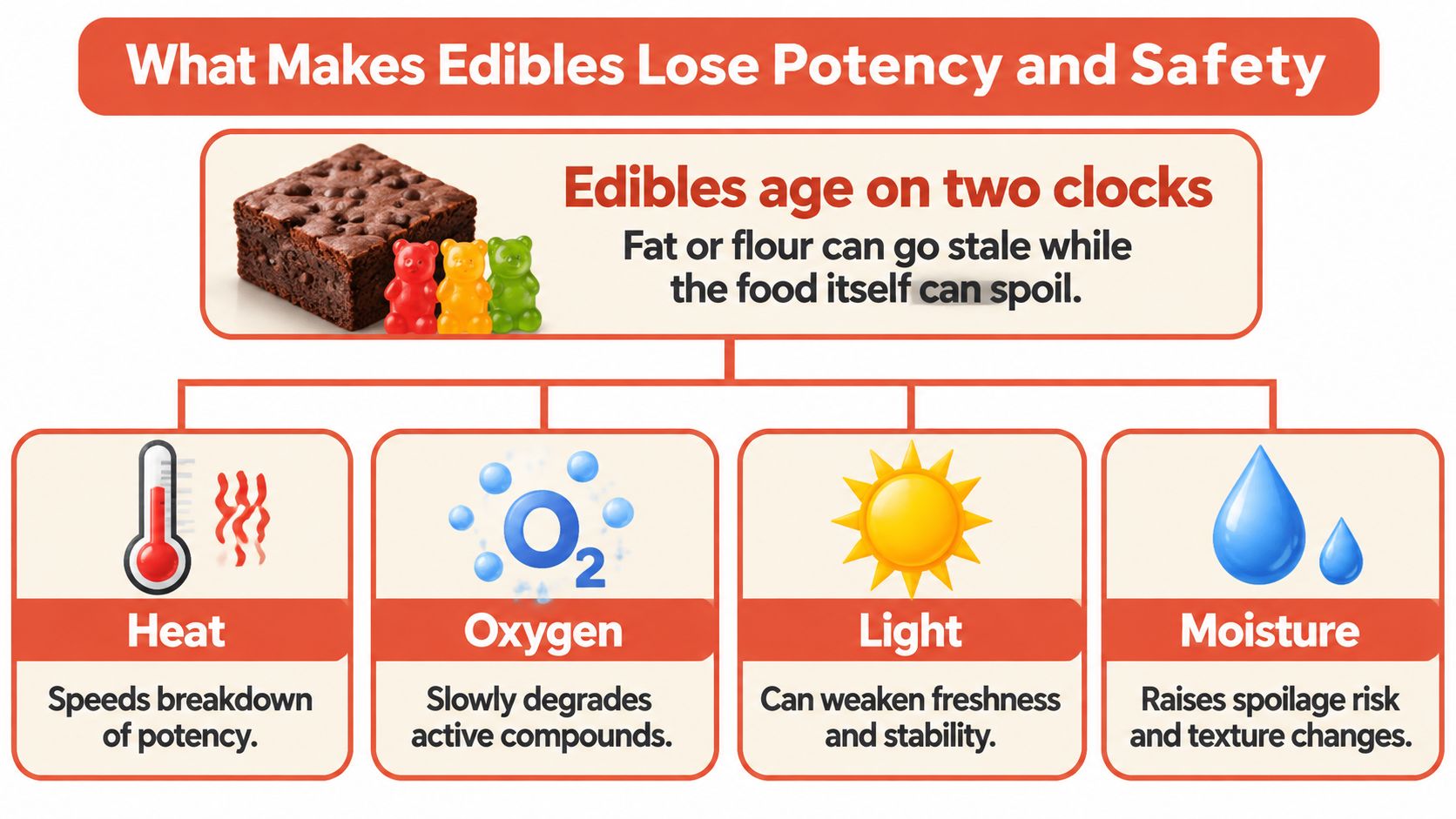
The Canadian food-industry factsheet on cannabis edible shelf life reports that high temperatures can accelerate degradation affecting THC and CBC potency, while oxygen and light also reduce cannabinoid shelf life. Nevada's 2024 shelf-life bulletin says the THC molecule is known to degrade by approximately 10% over one year and limits shelf-life extensions to one year under that framework.
Don't treat that 10% figure as a promise for your product. Formulation, packaging, starting potency, and storage history all change the rate. A sealed, cool, dark package and a half-open pouch in a hot kitchen won't age alike.
Potency loss is chemical and usually gradual. Microbial spoilage is biological and can move much faster in a moist product. That's why testing looks at microbial growth alongside potency and water activity or pH, which helps show whether a food can support growth.
Heat damage can even change the food structure itself. Our guide on whether you can melt gummies explains why fused servings create a dosing problem.
Practical rule: Cool, dry, dark, and sealed slows both clocks at once.
A printed date isn't a universal cannabis rule. It's the manufacturer's stability-based limit for a sealed product stored according to the package directions. If you've stored it in heat or opened it months ago, the practical limit may already have passed.
Stability testing checks more than whether THC is still present. It can cover potency, microbial safety, and water activity while accounting for temperature, humidity, light, and packaging. That's why two products made in the same week can carry very different dates.
| Element | What it tells you | Where to check |
|---|---|---|
| Expiration or best-by date | Stability-based limit for a sealed product stored as directed | Front or side of package |
| Storage instruction | Conditions the date assumes | Back of package |
| Batch or lot number | Links the product to its test results | Packaging, often near the date |
| Certificate of analysis (lab report) | Potency, microbial, contaminant results and test date | Brand website or QR code |
| THC per serving and per package | Dose basis for judging potency loss | Nutrition-style label panel |
People often assume best-by means safe but stale and expiration means dangerous the next day. For edibles, it's safer to read both as the end of the period the maker will stand behind. A product past its date may still be intoxicating while no longer meeting its documented specifications for potency, contamination, texture, taste, or moisture.
That distinction matters for dosing. Still feeling something doesn't prove the serving contains the labeled amount. It only proves some cannabinoids remain.
Start with the batch or lot number on your package. Then open the certificate of analysis and confirm that the same number appears there. If the numbers don't match, the report describes a different production run and tells you little about what's in your hand.
Next, compare the test date with the production or packaging date. They should sit close together in the product's timeline. A report with no batch link, no test date, or results for a different product isn't useful verification.
Our walkthrough on how to read a certificate of analysis shows where potency and contaminant results usually appear. Keep it simple: date, storage instruction, batch number, matched report, and labeled dose. Together, those five items show whether the product was made and documented to a clear standard.
Should you refrigerate your gummies because cold storage helps flower? That's where a lot of advice goes wrong. Much long-term cannabinoid research tested plant material, hash, extracts, oils, and isolates, not finished foods with gelatin, chocolate, flour, or fruit ingredients.
The storage options below show why the food itself has to guide your choice.
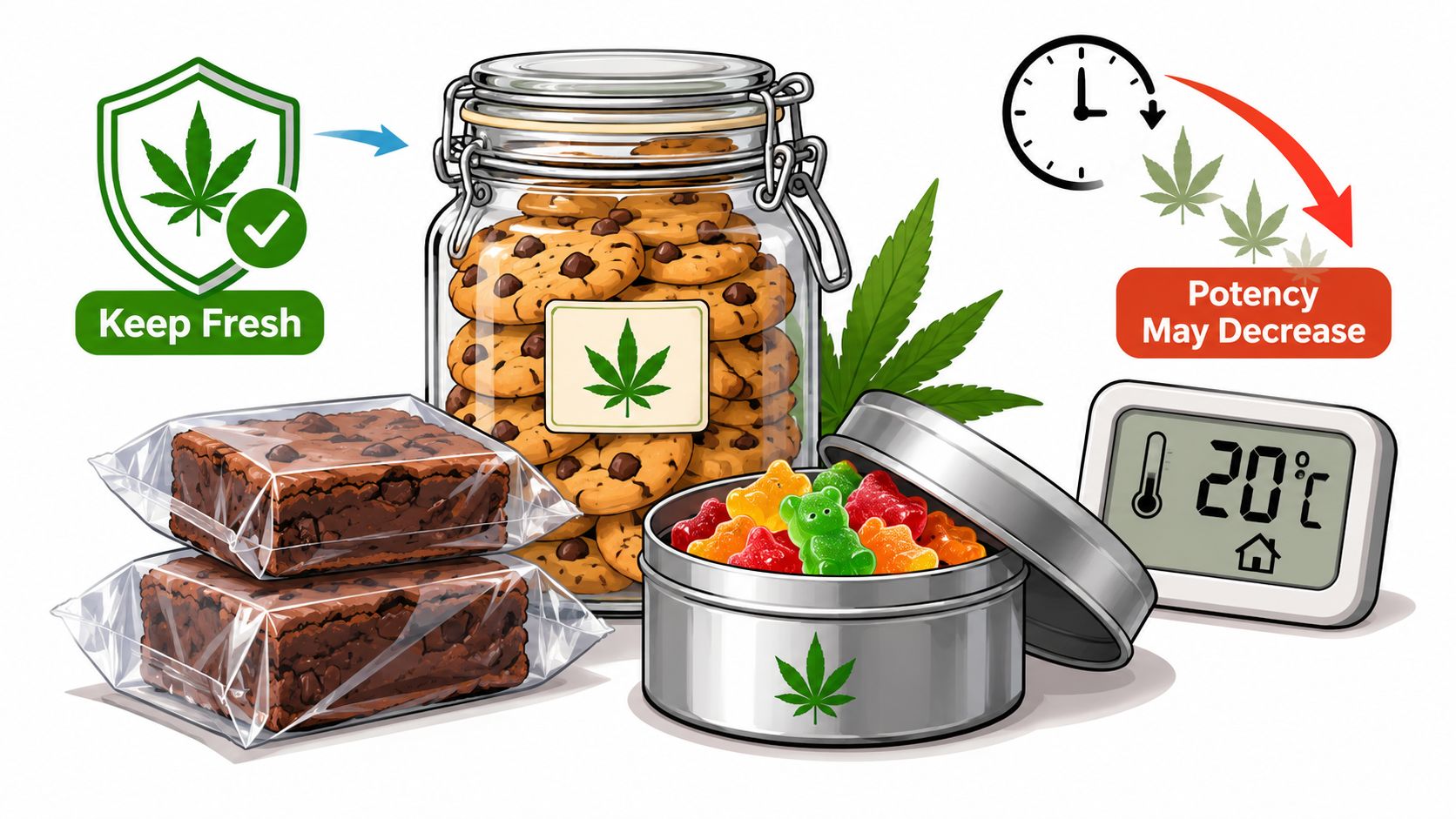
A summary of long-term cannabinoid storage research reports that room-temperature storage accelerates THC conversion to CBN, while freezing preserves cannabinoids in the materials tested. That doesn't prove freezing is best for a brownie or a chocolate bar. Processing and preservation methods affect both food ingredients and cannabinoid stability.
Refrigeration can create condensation when a cold package comes back into warm air. That extra moisture can make gummies sticky, harden gelatin, change chocolate texture, or move water through a baked good. Freezing can also damage texture and packaging if you thaw and refreeze the product repeatedly.
The same label-first logic applies to other formats, which is why our guide on how to store THCA products separates general cannabinoid care from product-specific instructions.
This short video walks through the visual checks that pair with the routine above.
Ask one question before you move any edible to the fridge or freezer. What storage condition preserves this specific formulation without damaging the food?
Will it still work? Possibly. A past-date edible can remain intoxicating while falling outside the maker's documented specifications, so any number you calculate is an estimate, not a guarantee.
Start with the labeled THC per package and, if you have it, the batch certificate of analysis. The label gives you the intended dose. The report gives you the tested starting point for that batch.
For a cautious planning figure, you can apply roughly 10% THC loss over one year to a well-stored product. Don't apply it mechanically to every gummy, chocolate, or baked product. Heat, light, air exposure, and an unknown storage history can justify assuming more loss.
Say that hypothetical 10 mg gummy is a year old and was kept sealed in a cool cabinet. Your planning estimate might put it near 9 mg, but you still can't verify that by looking at it. Starting with half protects you if the estimate is wrong in either direction.
Never eat extra pieces upfront to make up for assumed weakness. You can wait and take more later, but you can't undo a dose.
A baked good past its date is different. Treat it as a food-safety question first, not a math problem.
Ask two separate questions before you use an older edible. Is it unsafe to eat? And is it weaker than labeled? The first answer decides whether it goes in the trash. The second only affects dosing.
| Sign | Likely meaning | Action |
|---|---|---|
| Visible mold or fuzz | Microbial spoilage, especially in baked or moist products | Discard the whole package |
| Sour, rancid or unusual odor | Fat or moisture breakdown, or microbial growth | Discard |
| Leaking, swollen or broken seal | Moisture or microbial activity | Discard |
| Hardened, sticky or crumbly texture | Moisture movement or heat exposure | Safe-looking if sealed and in date, but potency uncertain; discard if other signs appear |
| White film on chocolate | Fat bloom from temperature cycling | Usually harmless if smell and taste are normal |
| Faded flavor, dry gummy | Slow oxidation and moisture loss | Treat as weaker and dose cautiously |
Mold means discard the whole package. Don't cut around a fuzzy spot on a brownie or pick out one clean-looking gummy from a contaminated pouch. Growth you can see may not be all that's there, and taste-testing a suspicious product doesn't make the check safer.
Texture changes need more judgment. A hardened gummy in a sealed, in-date package may have lost moisture, while the same change beside an off smell points to a bigger problem. White film on chocolate is usually bloom, but a rancid or paint-like odor changes the decision to discard.
That last step is easier when brands make testing traceable. Our flower, prerolls, edibles, and other products are lab-tested, and we use third-party certificates of analysis for potency and purity on every drop. Keep the report accessible for the life of the product, because a batch number without its matching paperwork doesn't help you months later.
When the history is unknown, the label is unreadable, or servings have melted into one unmeasurable mass, replace the product. Guessing at safety or dose isn't a reasonable trade for saving one edible.
When you're replacing an old edible, choose one with a readable date, an intact seal, clear milligrams per serving, and a batch you can verify. At Melt, our edibles and other products are lab-tested with third-party certificates of analysis for potency and purity on every drop, so you can check the paperwork before you buy. Browse the current lineup, confirm the batch details, and store your new package cool, dry, dark, and sealed from day one.
Your cart is currently empty.